
If you have curly or coily hair, you are already working with one of the best textures for forming strong, lasting dreadlocks. The natural curl pattern creates built-in friction and interlocking structure that helps hair mat and lock faster than straighter textures. The practical challenge is not whether your hair can loc, but how to start correctly, protect the hair you already have, and retain the length your scalp is producing every single month.
How to Grow Dreads with Curly Hair: Science-Based Guide

Simone Okonkwo
12 Jul 2026
Who this guide is for
This article is for anyone with curly, coily, or textured hair who wants to start dreadlocks and actually keep them healthy over time. That includes Type 3 (loose to tight curls) and Type 4 (kinky, coily, Afro-textured) hair, and it also covers adaptations for people with straighter or looser textures who want to understand what is different for them. Along the way, I address the related concerns I hear most often: starting from very short hair, working with thinning edges, dealing with bald patches, and figuring out whether your scalp health is a factor. I approach all of this through an evidence-based lens while respecting the cultural weight that locs carry for many communities. You will not find unverifiable growth promises here. What you will find is practical, honest guidance grounded in how hair actually behaves. If you're undecided about committing, read Should I grow dreads for a practical decision checklist.
Hair growth vs length retention, what actually determines progress
Your scalp grows hair at roughly 0.35 mm per day, which works out to about 1 cm (just under half an inch) per month and around 15 cm per year. That rate is largely set by genetics, hormones, nutrition, and age. No hairstyle, oil, or product changes the follicle's output in any meaningful way for most healthy people. When people say locs 'make your hair grow faster,' what they are often observing is improved length retention, not accelerated follicular growth.
Length retention is where locs genuinely shine as a protective style. Coily and kinky hair is structurally more fragile at each curl point than straighter textures. The tighter the curl, the more points of mechanical vulnerability exist along each strand, and breakage at those points is the main reason many people with Type 4 hair seem to gain very little length over time even though their follicles are producing normally. Locs reduce the constant detangling, combing, and manipulation that cause that breakage. The hair that your scalp grows simply has a better chance of staying attached to your head.
Understanding this distinction matters before you start. The goal is a healthy scalp producing hair at its natural rate, combined with a maintenance routine that minimizes breakage and physical damage. Anything that compromises scalp health or applies chronic tension works against both of those things, regardless of how good it looks in the short term.
How dreadlocks actually form
Locs form through a felt-formation process. When hair strands are subjected to repeated mechanical action and friction over time, the cuticle scales on neighboring strands catch on each other, tangle, and eventually mat together into a consolidated structure. This is not a chemical bonding reaction and it is not magic. It is the same physical mechanism that causes hair to mat on a neglected pillow or inside a hat, just guided deliberately and shaped over time.
Curl pattern accelerates this process significantly. Curly and coily strands naturally wrap around and intersect with neighboring strands because of their geometry. That built-in tendency to interlock means Type 4 hair can begin showing early loc structure within weeks of starting, while straighter hair may take months without mechanical assistance. Shrinkage is a related factor: highly coily hair can appear to shrink to 50 to 75 percent of its actual length as it dries and coils tighten, which concentrates strands and increases internal friction inside each forming loc. Over time, as the loc consolidates, that apparent shortness will gradually extend as the internal structure stabilizes and the loc 'budges' outward.
One important note: products that deposit insoluble films on the hair surface can slow or disrupt this process. Silicones (like dimethicone found in many conditioners) and heavy waxes coat the cuticle and reduce the friction that felt-formation depends on. Wax-based loc starters in particular are a problem I see come up repeatedly. They may make new twists look neat and shiny, but residue accumulates inside the forming loc over weeks and months, trapping debris, promoting odor, and complicating any medicated scalp treatment you might need later. The review Hair Cosmetics: An Overview - PMC (discussion of insoluble deposits and product build‑up) documents that waxes and heavy butters leave insoluble deposits that can adhere inside locs, increasing odor and making cleansing and medicated scalp treatments more difficult. Skip waxes and heavy butters on your roots and forming locs entirely.
Choosing a starting method: what to think about first
Before picking a method, honestly assess four things: your hair texture and curl pattern, your current hair length, how much maintenance time you realistically have, and the state of your scalp. Each of these shapes which method will work best and what your first six months will look like.
- Texture and curl pattern: Tighter, coilier hair (Type 4a through 4c) locks most readily and suits twists, coils, and freeform starts. Looser curl patterns (Type 3) may need more structure to hold starter locs. Straight and wavy hair generally requires backcombing, crochet, or braided starts.
- Hair length: Most methods need at least 3 to 4 cm (roughly 1.5 inches) of hair to grip and form a stable unit. Very short hair has fewer options, though finger coils and certain interlocking systems can work at shorter lengths.
- Maintenance commitment: Some methods (interlocking, crochet) require less frequent upkeep early on. Twist-based starts need more regular re-twisting in the early weeks to hold their shape before matting sets in.
- Scalp health: Active scalp infections, inflamed folliculitis, or severe seborrheic dermatitis should be controlled before you start. Locs make medicated scalp access harder, especially once the loc thickens. A dermatologist or trichologist visit is worth it if you have had persistent scalp issues.
Starting methods compared: curly vs straight hair
| Method | Best for | Pros | Cons | Wax/product risk |
|---|---|---|---|---|
| Two-strand twists | Type 3c to 4c curly/coily | Low manipulation, natural-looking start, low tool requirement | Can unravel before locking, needs regular re-twisting early on | Low if using light oils only |
| Finger/comb coils | Type 4a to 4c tightly coily | Fast setup, small uniform sections, locks quickly with coily texture | Fragile in early weeks, water can loosen coils before budding | Low |
| Twist-and-rip | Type 3 to 4 curly/coily | No tools needed, good for medium lengths, encourages early matting | Can cause uneven sections if not careful, slightly more manipulation | None required |
| Interlocking | Type 3 to 4 or any texture with fine/soft hair | Stable from day one, less unraveling, suits finer curly hair | Technique-dependent, over-tightening risks traction damage, needs professional start ideally | None required |
| Neglect/freeform | Type 4 coily/kinky | Zero manipulation, minimal tool/product requirement, natural variation | No control over loc thickness or grouping, takes longest to look intentional | None |
| Backcombing | Straight to wavy (Type 1 to 2) | Immediately defined locs on low-texture hair, controllable thickness | High early cuticle friction, risk of breakage if done aggressively, locs can feel rough early | Low to moderate if using holding product |
| Crochet/instant locs | Straight, wavy, or looser curly | Immediate loc appearance, works on most textures | High mechanical manipulation of cortex/cuticle, risk of shaft damage with repeated sessions | None required but technique risk is high |
| Braided/extension start | Straight to loose curly, or very short hair | Adds length structure, suits hair too short for other methods | Extensions add weight, scalp tension must be monitored carefully | Low if using appropriate hold spray |
My general recommendation: if you have Type 4 coily hair, start with two-strand twists or finger coils. If you have a looser curl pattern (Type 3 range), twist-and-rip or interlocking will give you more structural stability. If your hair is straight or wavy, backcombing is the most established route, but be gentle and consider having a skilled loctician do your crochet start rather than attempting it alone on dry hair.
Step-by-step starting methods for curly and textured hair
Twist-and-rip
This is one of my favorite methods for curly hair because it requires no tools and encourages early matting by separating fibers within the section before the loc forms. Start on freshly washed, towel-dried hair with no conditioner. Section your hair into uniform squares or diamonds using a rat-tail comb, keeping sections at least 1 cm apart to allow for loc growth. Take one section, twist it tightly from root to tip, then gently pull the two halves apart about halfway down. Re-twist, then pull apart again. Repeat four to six times per section. The goal is to roughen the interior fibers and encourage tangling without snapping the strand. Finish by securing each section with a small elastic at the tip if needed. Re-twist loose sections once a week for the first four to six weeks, then allow them to mat naturally.
Finger coils
Finger coils work best on Type 4 hair with good natural spring. Wash your hair, apply a small amount of a light water-based gel or aloe vera gel (no silicones, no wax), and work in sections while the hair is wet. Take a small section, place your finger at the root, and coil the hair around your finger from root to tip in the direction of your natural curl. Slide your finger out and allow the coil to spring into shape. Let your hair air-dry completely before touching the coils. Disrupting coils while damp causes frizz and section merging. Expect some unraveling in the first few weeks. Simply re-coil those sections and continue. By weeks six to ten on Type 4 hair, most coils will begin to bud and hold without re-coiling.
Two-strand twists
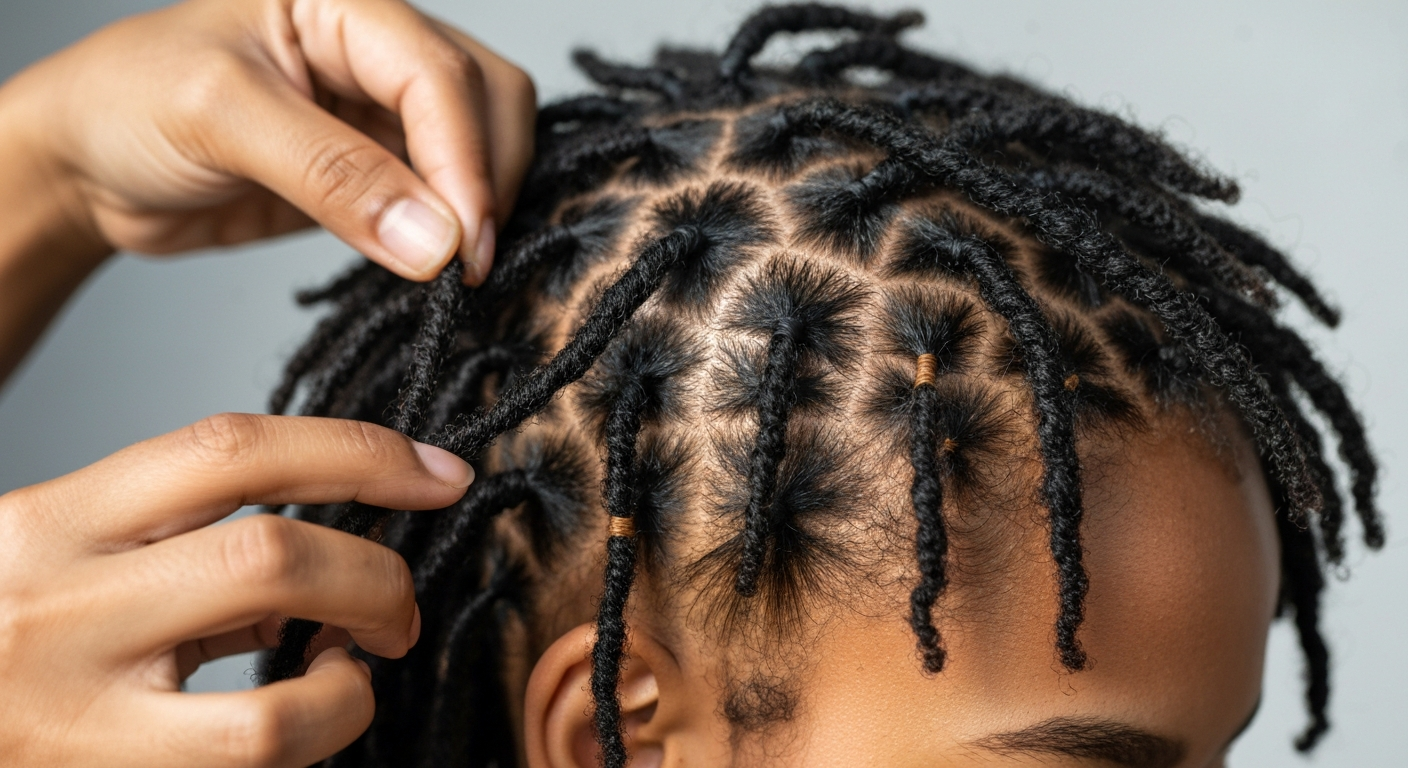
This is probably the most common starting method for textured hair and for good reason. It is gentle, controllable, and works across Type 3 to Type 4 textures. On freshly washed hair, section into your planned loc grid. Take one section and divide it into two equal parts. Twist the two strands around each other from root to tip, keeping consistent tension (firm but not tight enough to pull the scalp). Secure the tip with a small clip or twist it around itself. The main challenge with two-strand twists is unraveling before the hair has budded. Wearing a satin bonnet at night, avoiding manipulation during the day, and limiting water exposure in the first few weeks all help hold the twists until matting sets in.
Interlocking
Interlocking uses a latch hook tool or your fingers to pull the tip of a loc through the root section in a rotating pattern, creating a tight, stable knot at the base. It works on most curl patterns and is especially useful for people with fine or softer curly hair that unravels with twists. The advantage is that sections are stable almost immediately and do not need re-twisting. The risk is over-tightening. Following the guidance used by formal interlocking systems like Sisterlocks, root retightening intervals should sit in the 4 to 6 week range during the early phase and can extend to 4 to 8 weeks as locs mature. More frequent root work than that increases the likelihood of thinning at the base over time. I strongly recommend getting your first interlocking session done by a certified loctician and learning the correct rotation pattern before attempting it yourself.
Neglect/freeform (soapless start)
The neglect method involves washing your hair regularly with a residue-free shampoo but performing no sectioning, styling, or manipulation. You simply allow the hair to mat naturally over time. On Type 4 coily hair, the natural geometry of the strands will cause them to find neighbors and begin matting within a few months. The trade-off is that you have no control over section size or loc grouping. Some locs will combine into larger ones. This is normal and acceptable in freeform locking culture. What this method is not is completely without hygiene requirements. The 'soapless' framing is a myth I want to address directly: unwashed scalps develop sebum buildup, odor, and an environment that favors fungal and bacterial overgrowth. Wash your scalp weekly with a clarifying or residue-free shampoo regardless of method. A clean scalp supports the follicles producing the hair you are trying to retain.
Adapting for straight and low-texture hair
Backcombing
Backcombing is the baseline method for straight and wavy hair. Section your dry hair into your planned loc grid, then take a fine-tooth or metal comb and push the hair backward toward the scalp in short, firm strokes rather than raking through the shaft. Work from the tip up toward the root, building a compressed, matted mass. The key is applying deliberate pressure without forcing the comb through tangles aggressively. Once a section is backcombed into a firm, sausage-like column, palm-roll it between your palms to encourage a cylindrical shape. Secure with an elastic at the tip. Straight hair will not hold this shape as naturally as curly hair and will require more frequent palm-rolling and potentially a light aloe or water-based gel (no silicones, no wax) to hold shape in the early weeks.
Crochet start
A crochet hook is used to pull loose hairs into the forming loc, instantly creating a more defined, consolidated structure. This can produce immediate-looking locs on virtually any texture and is popular for people who want the appearance of mature locs from the start. The concern here is mechanical: the hook physically disrupts the cortex structure of the hair shaft when used aggressively or on the same section repeatedly. I recommend this only as a professional technique, not a DIY method on dry hair. Done correctly on damp hair by a skilled loctician, it is effective. Done incorrectly, it causes breakage and rough, weakened sections that will thin over time.
Braided or extension start
For people with straight or loosely wavy hair that is also short, braids or extension-based starts provide structure that other methods cannot. A loctician braids small, uniform sections (with or without added hair for length) and over time those braids mat and loc from the inside out. This approach requires careful monitoring of scalp tension, especially where extensions are attached. Added weight and any pulling at the root can contribute to traction damage over time, particularly around the hairline and temples. Keep extensions lightweight and ensure your loctician is not pulling the attachment points too tightly.
Maintenance that actually protects your growth
Washing and scalp care
Wash your scalp, not just your locs. Apply shampoo directly to the scalp using the pads of your fingers or a scalp applicator bottle, and work it in with light circular movements rather than scrubbing. Rinse thoroughly. On forming locs (the first three to four months), wash once a week and let hair air-dry completely before sleeping. Incomplete drying inside locs creates conditions for mildew and fungal growth. If you have seborrheic dermatitis or recurring scalp irritation, a ketoconazole-based shampoo used for five to ten minutes before rinsing is the evidence-backed first-line approach. Avoid letting heavy residue accumulate. Clarify with a residue-free or apple cider vinegar rinse once a month to remove buildup.
Moisturizing without disrupting loc formation
Coily hair needs moisture to resist breakage, but the wrong products will slow loc formation and create residue problems. The safest approach is water-first hydration: a light mist of water or aloe vera juice applied to the scalp and loc shaft a few times a week, followed by a very light oil like jojoba or argan applied to the length (not the root). Avoid glycerin-heavy products in very dry or very humid climates. In low humidity, glycerin can pull moisture out of the fiber. In high humidity, it can cause swelling and frizz that disrupts forming locs. Neither outcome helps you. Also avoid any product with dimethicone or similar silicone polymers. These coat the cuticle, block moisture absorption, and resist washing out, building up inside locs over weeks.
Retightening and root maintenance
Regardless of method, more is not better when it comes to root work. Chronic tension at the root is one of the most reliable causes of traction alopecia. I see this pattern over and over: someone starts locs and then retightens or re-twists every few days because they want everything to look perfect. The follicle cannot handle that repeated pulling indefinitely. For twist-based and coil-based starts, re-twist only when sections have visibly unraveled, generally every two to four weeks in the early months. For interlocking, stick to the 4 to 6 week minimum. For palm-rolling (mainly on backcombed straight hair locs), once every two weeks is sufficient.
Protective practices between washes
- Sleep on a satin or silk pillowcase or use a satin bonnet or durag every night. Cotton absorbs moisture and creates friction that disturbs forming locs.
- Avoid tight headbands or hats that create a consistent pressure line across the same part of the scalp.
- Do not pick apart or pull individual locs out of curiosity. The interior of a forming loc is in a fragile, active matting stage and disrupting it sets the process back.
- Keep forming locs away from chlorinated or saltwater without protection. If swimming, wear a swimming cap or apply a light oil barrier before water exposure and clarify-wash immediately after.
- Stay on top of scalp moisture. A dry, tight scalp is a signal worth paying attention to, not ignoring.
Short hair, thinning hair, receding hairlines, and bald patches: what is actually possible
This section deals with the questions I get most often from people who feel like they have a complicating factor. None of these situations are automatic disqualifiers for starting locs, but each one requires honest expectations and sometimes a different approach or a medical consultation first.
Starting dreads from very short hair
The minimum workable length for most starting methods is around 3 to 4 cm. Below that, there is simply not enough strand length for coils or twists to hold a shape. On Type 4 coily hair, finger coils can sometimes work at slightly shorter lengths (around 2 cm) because the natural spring of the curl holds the coil together. On straighter textures at short lengths, a braided extension start is the most practical route. The extensions add structure and length while your natural hair grows in underneath. The important thing at this stage is patience: locs started from very short hair will go through a long seedling phase that can look unfinished for six months or more. For a fuller picture of starting from minimal length, the considerations around method, length, and timeline all deserve their own detailed treatment. For a step-by-step plan on how to grow dreads from short hair, see our guide on how to grow dreads from short hair.
Thinning hair
If your hair is thinning diffusely, the first priority is identifying why before starting locs. Diffuse thinning can reflect nutritional deficiency, hormonal changes, stress-related telogen effluvium, or early androgenetic alopecia. Starting locs on actively thinning hair is not inherently harmful, but it makes it harder to monitor changes, and any method that adds tension could accelerate visible thinning in vulnerable areas. For specific guidance and practical precautions, see can I grow dreads with thinning hair. If the thinning is due to a treatable cause, address that first. Topical minoxidil is an evidence-supported option for non-scarring alopecias and can be used during loc maintenance, though application to a scalp covered with dense, maturing locs is logistically harder than on natural hair. A dermatologist can help determine whether thinning is shedding (temporary) or loss (potentially progressive) and what intervention is appropriate.
Receding hairlines
The hairline is the area most vulnerable to traction damage. If your hairline is already receding, you need to be especially careful about any method that places tension at the front and temples. If you're asking "can you grow dreads with a receding hairline", the short answer is yes, many people can, but you must adapt techniques to minimize tension at the front and consult a specialist if follicles show long-term damage. Avoid tight perimeter locs, eliminate any pulling at the hairline during maintenance, and consider leaving the front locs slightly looser than the rest of your head. If your hairline recession is due to traction alopecia from previous styling rather than androgenetic causes, reducing tension and maintaining scalp health can allow some recovery in the early stages. If the follicles have been damaged long-term, recovery is less predictable, and a trichologist or dermatologist should assess the area before you start.
Bald patches
True bald patches (areas with no active hair growth) cannot be loced because there is no hair to work with. The surrounding hair can still be loced normally, and depending on the cause of the patch, some regrowth may occur over time. Alopecia areata, for example, often resolves on its own or responds to treatment, while scarring alopecias involve permanent follicle damage. If you have bald patches of unknown cause, see a dermatologist before starting locs. Getting a diagnosis matters because the treatment approach is completely different between inflammatory, autoimmune, and mechanical causes, and some conditions are worsened by the occlusion and tension that loc maintenance involves.
Realistic timeline: what to expect month by month
| Phase | Timeframe (Type 4 curly/coily) | Timeframe (straighter textures) | What you will see |
|---|---|---|---|
| Starter/seedling | Weeks 1–8 | Weeks 1–12 | Fresh twists, coils, or backcombed sections; some unraveling; little visible matting |
| Budding | Months 2–5 | Months 3–7 | Sections begin to hold shape without re-twisting; small knots form inside the loc; ends start to round off |
| Teen locs | Months 5–12 | Months 6–15 | Locs are defined but frizzy and uneven; shrinkage may make them appear shorter; internal structure consolidating |
| Mature locs | 12–24 months | 18–36 months | Locs are fully consolidated, hold their shape consistently, root growth is clear; length is now accumulating noticeably |
Shrinkage during the teen phase catches a lot of people off guard. Your locs may actually appear shorter at month eight than they did at month two. This is not breakage. It is the hair coiling and consolidating internally. The length is still there, folded inside the forming loc. It will release and extend as the loc matures and the internal structure stabilizes. This is one of the most common points at which people give up. Do not.
Signs it is time to see a professional
Locs are a long-term commitment and most of the journey can be self-managed with the right knowledge. But there are situations where professional eyes, either a skilled loctician or a dermatologist, are the right call rather than pushing forward alone.
- Persistent scalp pain, tenderness, or burning sensations, especially along the hairline or where locs are attached
- Visible scalp inflammation, pustules, flaking that does not respond to a clarifying wash, or any open sores
- Noticeable thinning at the base of individual locs or along the hairline that was not there when you started
- Bald patches appearing on or around the scalp after beginning loc maintenance
- Locs that have merged at the scalp without your intention, creating large, matted sections that pull on the scalp
- Any active scalp infection or rash that is not improving with over-the-counter antifungal shampoo after two weeks
- Receding hairline that is progressing despite reducing tension
Early traction alopecia is reversible if caught in time. Late-stage traction alopecia involves follicle scarring that is not. The window for intervention is real, and a dermatologist can also assess whether options like topical minoxidil or intralesional corticosteroids are appropriate for your specific situation.
Product dos and don'ts
| Product type | Use it? | Why |
|---|---|---|
| Residue-free or clarifying shampoo | Yes, weekly | Keeps scalp clean without leaving film that slows loc formation |
| Light water-based aloe gel | Yes, sparingly on forming locs | Provides light hold without residue; rinses clean |
| Jojoba or argan oil (light application) | Yes, on loc length only | Seals moisture; does not build up heavily |
| Glycerin-based moisturizers | Use cautiously, climate-dependent | Works in moderate humidity; can worsen dryness in low humidity or cause swelling in high humidity |
| Silicone-containing conditioners (dimethicone etc.) | No | Coats cuticle, blocks moisture, accumulates inside locs and resists washing out |
| Beeswax or wax-based loc pomades | No | High residue buildup inside locs; traps debris; complicates scalp treatment access; promotes odor |
| Heavy butters (shea, cocoa) on roots/scalp | No on scalp; minimal on length | Occludes scalp pores at high volume; accumulates inside forming locs |
| Ketoconazole shampoo | When medically indicated | Evidence-backed for seborrheic dermatitis; apply to scalp, leave 5–10 minutes, rinse well |
| Topical minoxidil | Under dermatologist guidance only | Evidence-based for non-scarring alopecia; requires consistent use; logistically harder to apply in mature locs |
Common myths, addressed directly
Locs make your hair grow faster. No. Your follicles grow hair at roughly the same rate with or without locs. What locs genuinely do is reduce breakage, which means more of that growth is retained as visible length over time. That is a real benefit, but it is a retention benefit, not a growth acceleration benefit.
You should not wash new locs for the first month. This is consistently wrong and potentially harmful. A clean scalp is a fundamental requirement for healthy follicles. Sebum, sweat, and environmental debris do not help locs form faster. Wash once a week from the start using a residue-free shampoo, and let locs air-dry completely.
Wax helps locs lock faster. Wax makes locs look more formed temporarily, but it does not accelerate the felt-formation process. The actual matting happens from friction and mechanical tangling of the hair fiber, not from adhesive coating. Wax residue inside a loc is extremely difficult to remove, and long-term wax users often end up with hardened, discolored locs that are structurally compromised.
Curly hair does not need moisture in locs. Curly and coily hair tends to be naturally drier because the curve of the follicle makes it harder for scalp sebum to travel down the shaft. This does not disappear when hair is loced. Dry hair is brittle and breaks more easily, which works directly against the retention benefit that locs are supposed to provide. Moisturize your scalp and loc length consistently, just with the right products.
FAQ
How fast does hair actually grow, and what determines how long my dreadlocks will get?
Scalp hair grows on average about 0.35 mm/day (≈1 cm/month, ≈12–15 cm/year), but visible length depends on two things: follicular growth rate (biologic) and length retention (how much hair breaks off). For curly/coily hair, breakage at the ‘curl points’ is the common reason for slow apparent growth—protecting the shaft and reducing mechanical stress improves retained length even if the follicle’s growth rate doesn’t change.
What physically makes hair form into dreadlocks?
Dread formation is a physical matting/felting process driven by friction, entanglement of cuticle scales, and repeated mechanical actions (twisting, rubbing, or neglect). Chemical damage or heavy product residue can accelerate matting, while textures with tighter coils naturally tangle and lock faster because fibres catch on each other more readily.
Which starter method is best for curly/ textured hair?
Curly/coily (Type 3–4) hair usually forms stable locs fastest with twist‑based methods: two‑strand twists, finger coils, twist‑and‑rip, or controlled neglect. These methods minimize early heavy manipulation of the cuticle while creating the inter‑fibre friction needed to lock. Choose a method that matches your desired loc size and maintenance tolerance.
How should people with straight or loose‑curl hair start locs?
Straighter/looser hair generally needs added structure: backcombing plus palm‑rolling, interlocking, or crochet/‘instant’ locs over braided or sectioned bases. These methods create initial friction and surface roughness. Expect more initial maintenance and be cautious—aggressive backcombing, frequent tight retightening, or heavy tension at the roots raises the risk of breakage and traction alopecia.
Step‑by‑step: how to start locs on curly/coily hair with two‑strand twists
1) Section dry or lightly damp hair into desired-size parts. 2) Apply a light leave‑in conditioner or styling cream (avoid heavy waxes). 3) Twist each section from root to tip in two strands, keeping moderate tension—don’t over‑tighten at the scalp. 4) Secure ends as needed (small rubber bands if necessary) but remove once the loc forms. 5) Maintain with gentle palm‑rolling and periodic retightening according to your chosen schedule.
Step‑by‑step: a straight‑hair backcombing + crochet starter (adaptation)
1) Section hair into desired loc sizes. 2) Backcomb each section toward the root with a fine comb to create bulk and roughness. 3) Palm‑roll the section to shape. 4) Use a fine crochet hook to pull loose hairs into the core for immediate definition (optional). 5) Avoid excessive root tension; keep early maintenance gentle to reduce traction risk.
Next Article
How to Grow Dreads From Short Hair: Fast, Safe Steps
Step-by-step plan to start and grow dreads from short hair, with fast timeline, sectioning, retwist, wash care