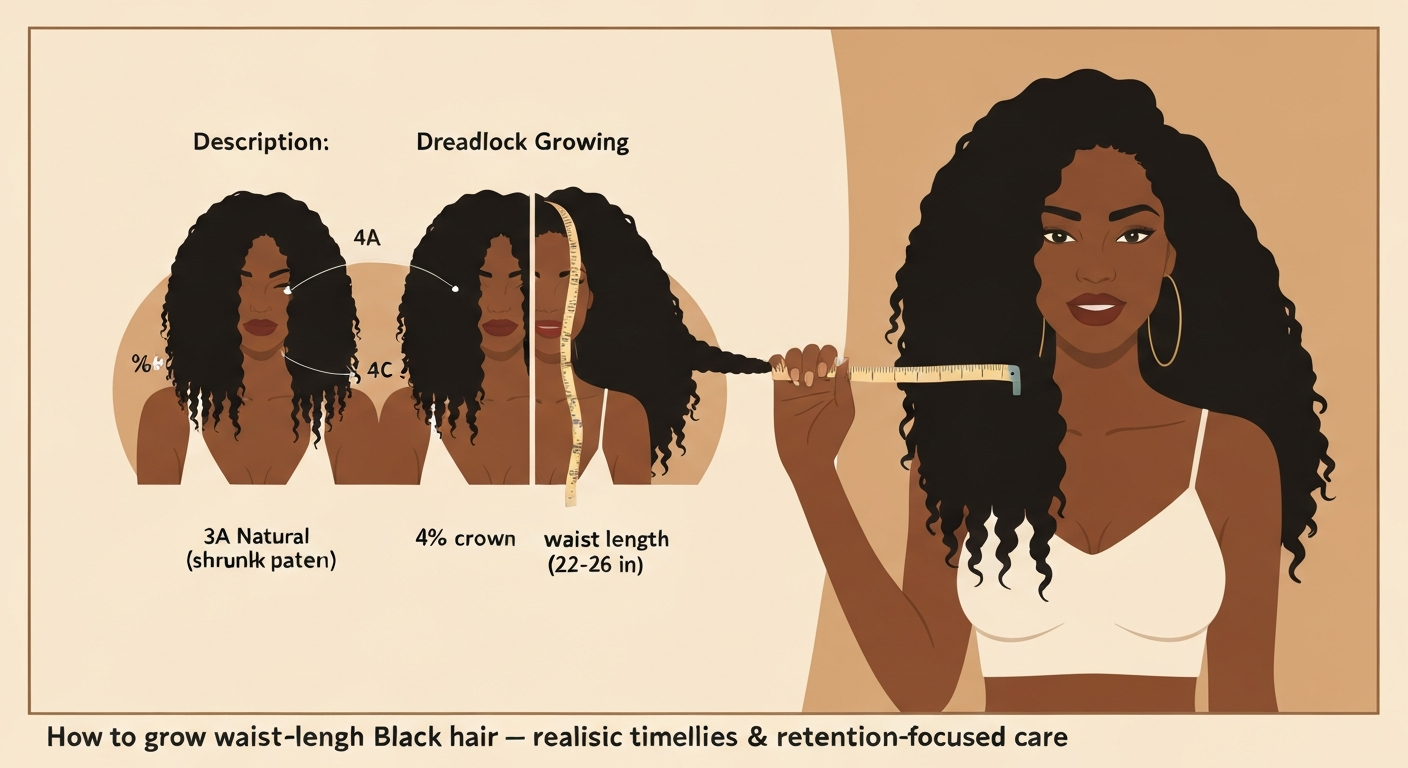
A wash-and-go will not make your hair grow faster. No styling method can do that. What it can do, when done well, is reduce the mechanical damage that causes breakage, which means more of the hair your follicles are already producing actually stays on your head and shows up as visible length. For people with textured and coily hair, that difference between true growth rate and retained length is everything, and a properly executed wash-and-go routine can genuinely move the needle on retention.
Can Wash n Go Grow Hair? Evidence-Based Guide for Textured

Simone Okonkwo
20 Jul 2026
Who this article is for and what the question actually means
If you have natural, textured, or Afro-textured hair and you have been wondering whether switching to a wash-and-go will help you grow your hair out, this is written for you. The question 'can wash n go grow hair' shows up a lot in search, and it bundles together two very different things: biological hair growth (what your follicles produce) and length retention (how much of that growth survives handling, dryness, and styling). I want to untangle those two ideas clearly, because confusing them leads to a lot of disappointment when a new routine does not produce the dramatic results you were hoping for.
Can a wash-and-go actually grow your hair? The direct answer
No, a wash-and-go does not increase your hair's biological growth rate. Your follicles cycle through anagen (active growth), catagen (regression), and telogen (resting) phases on a schedule driven by genetics, hormones, and growth factors like IGF-1 and FGF-5. External styling does not reach those molecular controls. The only interventions with clinical evidence for actually increasing follicular growth rate are pharmacological ones like minoxidil. Pathophysiology, conventional treatments, and evidence-based remedies of hair loss, systematic review (PMC) documents that proven increases in follicular growth rate come from interventions that alter follicle biology (for example, minoxidil) Pathophysiology, conventional treatments, and evidence-based remedies of hair loss — systematic review (PMC). What a wash-and-go can do is act as a low-manipulation approach that keeps breakage low and moisture high, so that the roughly 0.5 to 0.75 cm per month your scalp is already producing does not disappear before you see it. That is a meaningful, real benefit, just not the one the question implies. See the related article 'Do finger waves grow your hair' for how that specific style affects length retention versus follicular growth.
Hair growth versus length retention: the science you actually need
Here is the distinction I keep coming back to when I talk about any styling method and growth. Your scalp is producing hair continuously during the anagen phase. Research from Loussouarn's multi-ethnic hair studies measured mean daily growth rates across populations: African hair groups averaged around 256 micrometers per day (roughly 0.77 cm per month), Caucasian around 371 micrometers, and Asian around 421 micrometers. Those differences are real and documented, but crucially, they are driven by follicle biology, not by what products you put on your hair or how you style it.
The place where care and styling have genuine power is breakage. Textured and coily hair has a more elliptical cross-section and a tighter helical geometry than straighter types, which creates natural stress points along the strand. Every time you detangle without enough slip, sleep on a rough pillowcase, or stretch a dry curl too hard, you are snapping fibers that took months to grow. Scalp health matters too: a clean, well-circulated scalp supports follicle function, while product buildup and chronic tension can impair it. Traction alopecia is the extreme end of that spectrum, and it is directly associated with high-tension styles in populations with African ancestry. A wash-and-go, because it involves minimal ongoing tension, sidesteps that particular risk entirely.
How a wash-and-go can help or hurt your length
The wash-and-go works on a few key mechanisms at once. On the positive side, it is a low-manipulation style: once your curls are set, you are not combing, stretching, or re-styling them daily, which dramatically reduces the cumulative mechanical damage that causes breakage. Frequent washing with a good conditioner keeps your strands properly moisturized, and moisture is what keeps textured hair pliable rather than brittle. Because the scalp is regularly cleansed and exposed, product buildup is less likely to clog follicles or cause scalp irritation. And unlike tight braids or some extension styles, a correctly done wash-and-go puts essentially zero sustained tension on the hairline or the follicles, reducing the risk of traction-related shedding.
On the other side, wearing your hair out in a defined curl means your ends are exposed to friction from clothing, pillowcases, and environmental elements every single day. For tighter curl patterns (Type 4A through 4C coils), the geometric weakness of the strand combined with that daily abrasion can mean more breakage than a style that tucks the ends away. Single-strand knots, also called fairy knots, are another wash-and-go-specific problem for very tight coils: the natural helix of each strand can loop around itself or neighboring strands during drying, creating tiny knots that force you to either cut them or cause breakage when you detangle next wash day. The key takeaway is that the wash-and-go is not a universally protective style in the way a sew-in or a set of braids is. Its effectiveness for length retention depends heavily on your curl pattern, your technique, and how you maintain the style between wash days.
Wash-and-go for different curl patterns: what to realistically expect
Curl pattern and strand diameter genuinely change whether a wash-and-go will help or hinder your length retention. Curl pattern, strand diameter, and porosity modify mechanical vulnerability: tighter/Z‑shaped/coily hair shows greater geometric weakness and frictional tangling, increasing breakage risk compared with straighter types; those intrinsic properties therefore change whether an exposed, loose style (wash‑and‑go) will preserve or lose length for an individual Research shows that curl pattern, strand diameter, and porosity modify mechanical vulnerability: tighter Z‑shaped/coily hair has greater geometric weakness and frictional tangling, increasing breakage risk compared with straighter types.. Here is a practical breakdown by type:
| Hair Type | Wash-and-Go Strengths | Watch Out For | Length Retention Outlook |
|---|---|---|---|
| 2A–2C (Wavy) | Easy detangling, low knot risk, dries relatively quickly | Frizz in humidity, light product buildup | Very good with basic moisture routine |
| 3A–3B (Loose to medium curls) | Good curl definition, manageable detangling, low breakage risk | Dryness at ends, some friction frizz | Good; consistent moisture is the main lever |
| 3C–4A (Tight curls to coils) | Low tension vs. braids, scalp access for cleansing | Single-strand knots, more shrinkage, longer dry time | Moderate; technique and detangling care are critical |
| 4B–4C (Tight to very tight coils) | Near-zero tension, frequent moisture, scalp health benefits | High breakage risk from exposed ends and fairy knots, significant shrinkage | Variable; many find protective styles retain more length |
I want to be honest here: if you have 4C hair and you have been told that a wash-and-go is the magic solution for length retention, that is an oversimplification. It can absolutely be part of a healthy routine, but many people with very tight coils find that styles which protect the ends (tucked twists, braids, or even sew-ins done without excessive tension) retain more length over six months than a wash-and-go worn every day. That does not mean avoid the style, it just means set realistic expectations and monitor your own breakage.
A growth-focused wash-and-go routine: overview and frequency
The goal of this routine is to maximize moisture retention, minimize mechanical damage at every step, and keep the scalp in good condition. Frequency matters: most people with textured hair do best washing every 7 to 14 days. Going longer than two weeks without cleansing tends to allow product buildup that can irritate the scalp and weigh down the hair; washing more frequently than once a week can strip natural oils before they travel down the shaft, especially for tighter curl patterns. You will need to find your personal sweet spot based on your scalp type, your climate, and how much product you apply.
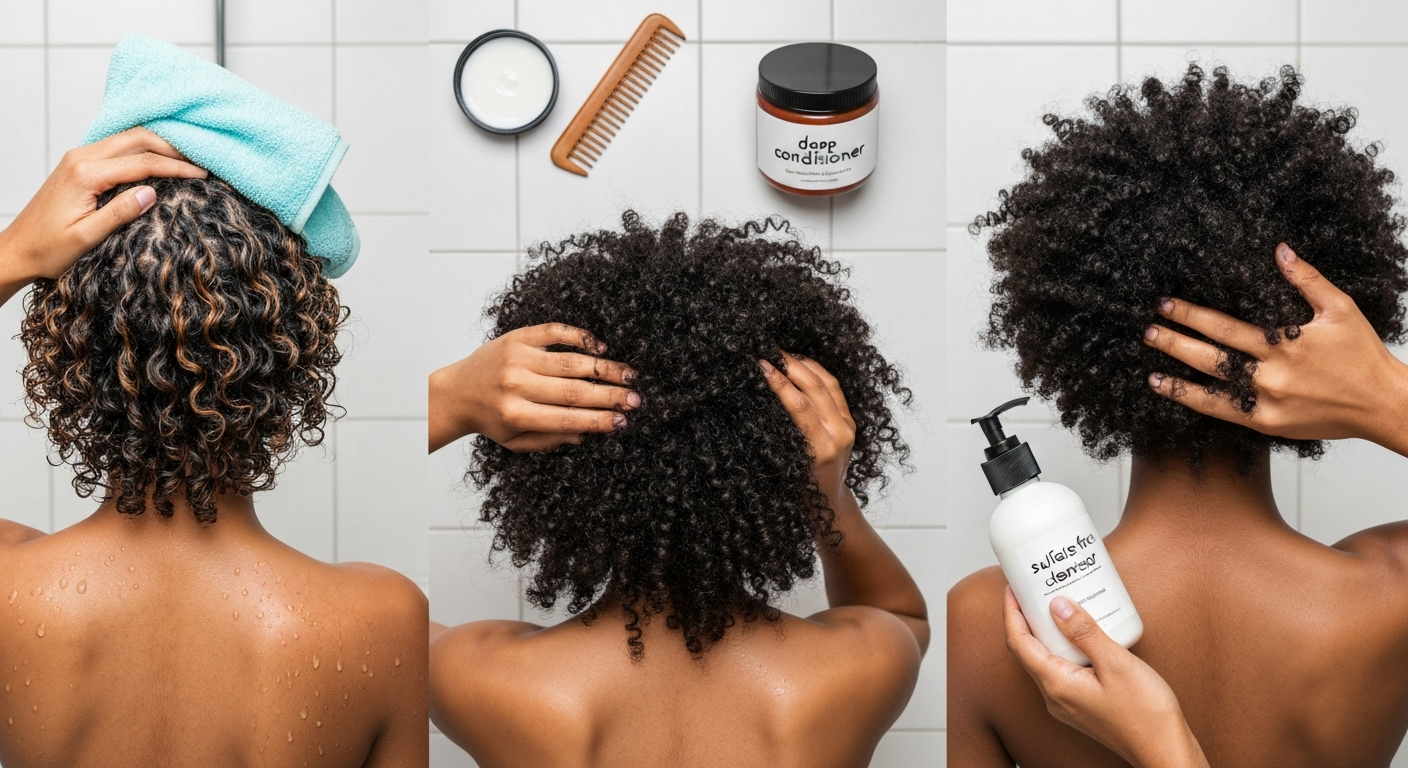
Step 1: Cleansing your scalp and strands
How often and what to use
The cleanser you choose has a direct impact on breakage. Sulfate-based shampoos (those containing sodium lauryl sulfate or sodium laureth sulfate) can strip the hair's natural lipid layer and increase cuticular damage, which is particularly relevant for textured hair that is already prone to dryness. That does not mean you need to avoid them entirely: sulfate shampoos, used once or twice a month as a clarifying step, are actually important for removing silicone and heavy product buildup that co-washing alone cannot clear. What you want to avoid is using a strong sulfate shampoo at every single wash.
For most wash days, a sulfate-free shampoo or a gentle cleansing conditioner is the better call. Look for formulas with humectant and conditioning ingredients (glycerin, panthenol, aloe vera) that clean the scalp without stripping the shaft. Apply the shampoo directly to your scalp, massage gently with your fingertips (not your nails), and let it rinse down the length of your hair rather than vigorously scrubbing the mid-lengths and ends. Also check for short-chain alcohols listed near the top of ingredient lists: alcohol denat., isopropyl alcohol, and ethanol used at high concentrations can be drying. Fatty alcohols like cetyl alcohol and cetearyl alcohol are fine and actually conditioning.
- Use a gentle sulfate-free shampoo or cleansing conditioner on most wash days (weekly or bi-weekly)
- Add a clarifying shampoo (can contain sulfates) once or twice a month to remove silicone and buildup
- Focus shampoo on the scalp, not on the lengths and ends
- Massage scalp gently with fingertips to support circulation without tangling the hair
- Avoid formulas where alcohol denat., ethanol, or isopropyl alcohol appears early in the ingredient list
- Rinse thoroughly — residue left on the scalp can cause itching and product buildup
Scalp care tips specific to wash-and-go wearers
One genuine advantage the wash-and-go has over some protective styles is unrestricted scalp access. Use it. A clean, healthy scalp is the foundation of healthy hair growth, and frequent washing gives you the opportunity to check for any flaking, tenderness, or thinning that might otherwise go unnoticed for months under braids or a sew-in. If you notice persistent scalp irritation, flaking, or unusual shedding, that is worth bringing to a dermatologist rather than trying to solve with another product. For locale-specific concerns, like how climate affects scalp conditions, see the guide titled 'do wavy caps grow in the UK' for UK-specific considerations and advice. No styling routine substitutes for a healthy scalp.
Step 2: Conditioning for growth and retention
Rinse-out conditioner versus deep conditioning
Conditioning is where you actually protect the hair shaft and set yourself up for less breakage at every subsequent step. Rinse-out conditioner should be a non-negotiable part of every wash day, no exceptions. It does three things: humectants in the formula (glycerin, hyaluronic acid, aloe) attract and hold water into the shaft; emollients smooth the cuticle and reduce fiber-to-fiber friction; and cationic conditioning polymers (like polyquaternium compounds or behentrimonium chloride) temporarily coat the strand to reduce the force needed for detangling. That last point is directly relevant to breakage reduction, which is the mechanism by which a wash-and-go routine can improve length retention.
Deep conditioning goes a step further by allowing those ingredients more time to penetrate the cortex and provide internal moisture. For textured hair, I recommend deep conditioning at least twice a month, or every wash day if your hair is particularly dry or high-porosity. Apply generously from roots to ends, cover with a plastic cap, and leave on for 20 to 30 minutes (using gentle heat from a hooded dryer or a heat cap speeds absorption if your hair is low porosity). Do not apply deep conditioner directly to the scalp if the formula is heavy or protein-rich; focus it on the mid-lengths and ends where the hair is oldest and most vulnerable.
Rinse-out conditioner frequency and goals
Use a rinse-out conditioner every single wash day. The goal is not just softness but reduced detangling force, which is the direct mechanical path to less breakage. Leave it in for at least two to three minutes before rinsing. If you are co-washing (using conditioner in place of shampoo between clarifying washes), make sure you are still clarifying regularly so that conditioning agents and styling products do not accumulate on the scalp to the point of causing irritation or follicle congestion. A note on silicones in conditioners: dimethicone and similar insoluble silicones provide excellent slip and frizz control, but they do require a proper sulfate-based clarifying wash every few weeks to prevent buildup. Water-soluble silicones (cyclomethicone, PEG-modified silicones) are easier to remove with gentle cleansers if you prefer to avoid that clarifying step.
Comparing the wash-and-go to other styles that readers here might be exploring, like sew-ins, braids, or twists, the conditioning step is the one area where the wash-and-go unambiguously wins. If you want a direct comparison, read our short guide on whether a sew-in will help you grow your hair, which contrasts protective styling retention benefits with the daily conditioning advantage of wash-and-gos. Styles that are left in for weeks at a time can become very dry at the ends without regular moisture application, and the hair underneath is not receiving active conditioning. The wash-and-go forces you to condition on a regular cycle, which is a genuine structural advantage for hair health over the long term.
FAQ
Short answer: can a wash-and-go make your hair grow faster or does it mainly help retain length?
Evidence-based short answer: a wash-and-go does not change the hair follicle’s biological growth rate. It can, however, help many people with textured/Black hair retain more visible length by reducing breakage and shedding when done correctly. True increases in follicular growth rate require interventions that alter follicle biology (e.g., approved topical or systemic treatments), not a styling method.
What is the difference between hair growth and length retention?
Hair growth refers to the follicle-driven production of new shaft (anagen phase) and is set by genetics, hormones, and molecular regulators. Length retention refers to how much of that grown hair remains unbroken or un-shed — determined by shaft damage, breakage, and care. Styling and grooming affect the shaft (retention), not the intrinsic follicle-driven growth rate.
Why does wash-and-go help some people keep length?
A well-executed wash-and-go can be low-manipulation: it reduces frequent combing/handling, uses conditioning slip to lower detangling forces, protects ends from repeated friction, and minimizes chemical/thermal stress. All of these actions reduce strand breakage and shedding, so more of the hair produced by follicles remains visible as length.
Which curl types are most and least likely to benefit from a wash-and-go for length retention?
Looser curl patterns (3A–3C) and thicker single strands often tolerate loose, out styles better and may see easier length retention with wash-and-go. Very tight/coily (4A–4C) hair has more geometric vulnerability (kinks, tangling, higher friction) and is more prone to breakage when left fully out — so wash-and-go can work but requires meticulous slip, sectioned detangling, and protective nighttime care to avoid loss. Individual porosity and strand diameter also modify outcomes.
Growth-focused step-by-step wash-and-go routine (cleansing, conditioning, detangling, styling, nighttime care) and frequency recommendations
Routine: 1) Cleanse: gentle sulfate-free shampoo or co-wash depending on oiliness/ product use; clarify monthly or when buildup occurs. Frequency: every 1–2 weeks for most; more often if scalp oily. 2) Condition: apply a rinse or deep conditioner with good slip (conditioning agents, silicones or cationic polymers, humectants) for 5–30+ minutes depending on porosity. 3) Detangle: work in small sections, apply plenty of conditioner/slip, detangle from ends → roots with fingers or a wide-tooth comb. 4) Style: apply lightweight leave-in and a defining product (gel/cream) while hair is wet to lock curl pattern and reduce daily manipulation; avoid heavy layering that causes buildup. 5) Dry: air-dry or diffuse on low heat; minimize high heat. 6) Nighttime: pinecone/banded loose pineapple, satin/silk scarf or bonnet, satin pillowcase; tuck ends into a satin scarf or use a loose protective wrap. Frequency: keep wash-and-go cycles to a level you can properly moisturize and detangle — typically 1–2 times per week to biweekly depending on hair and lifestyle.
Product ingredient guidance: what to choose and what to avoid?
Choose: gentle anionic surfactants (milder sulfates or sulfate-free), conditioning cationic polymers, silicones that are water-dispersible or easy-to-clarify (e.g., dimethicone copolyols), humectants (glycerin, propanediol, hyaluronic acid), emollients (shea butter, fatty alcohols), and proteins only if your hair responds to them. Avoid or limit: harsh sulfates (SLS/SLES) if they cause dryness, high concentrations of short-chain volatile alcohols (ethanol denat.), frequent heavy insoluble silicones without regular clarifying, and harsh chemical relaxers or high-heat styling that increase breakage risk.
Next Article
How to Grow Waist-Length Black Hair: Evidence-Based Guide
How to grow and retain waist-length Black hair: realistic timelines, routines, protective styles, and evidence-basedTips