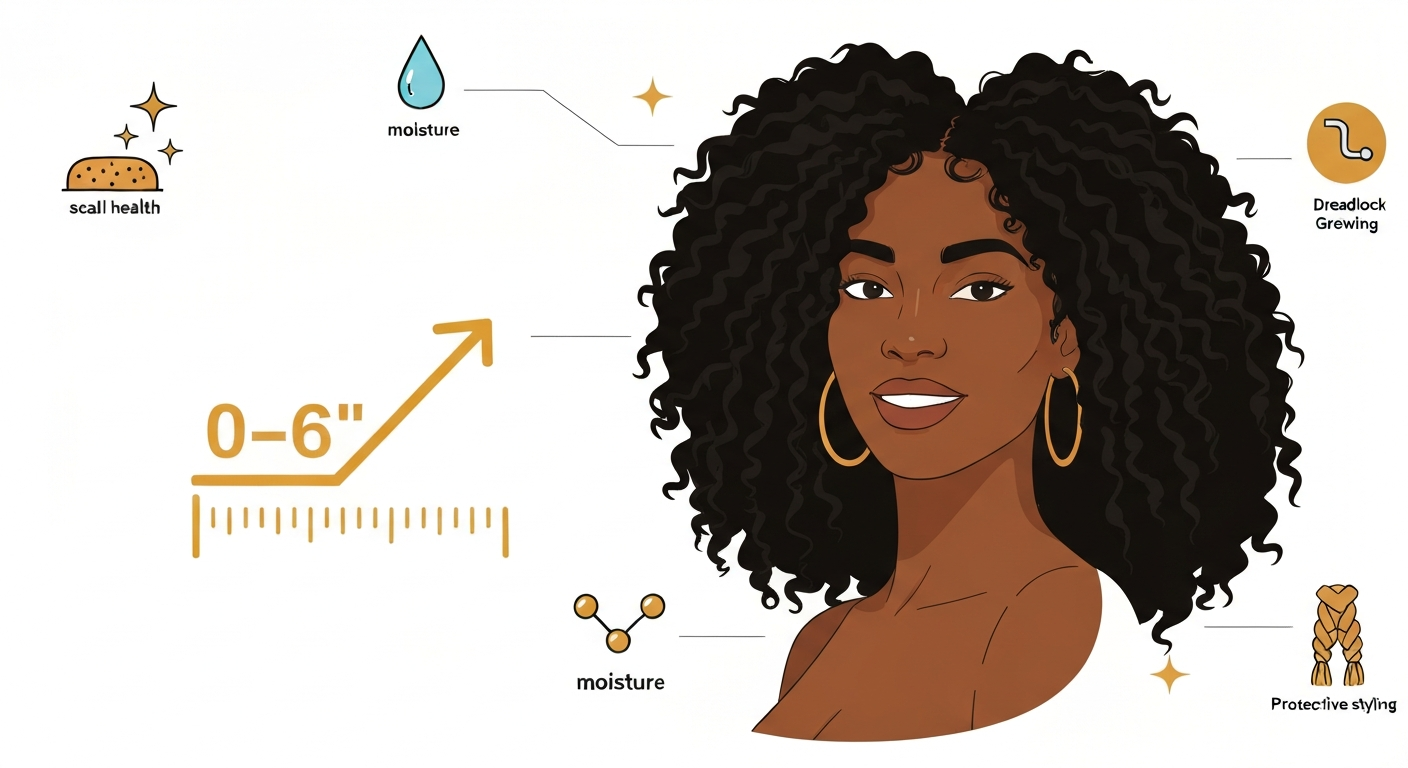
Yes, relaxed Black hair can grow long, and it can do so faster than most people expect once you shift your focus from the scalp to the strand. Your follicles are already producing hair every single day. The real job is keeping that hair on your head long enough to show up as length, and that means protecting the chemically altered strand from the breakage that quietly erases months of growth.
How to Grow Black Relaxed Hair Long and Fast, Evidence-Based Plan

Simone Okonkwo
9 Aug 2026
Who this guide is for
This guide is written for Black women and men who use chemical relaxers, who are transitioning between relaxed and natural styles, or who go back and forth depending on the season or their styling goals. If you have been stuck at the same length for years despite trying every oil and vitamin on the market, this is for you. We are going to cover what your scalp actually produces, why retention beats growth rate every time, how relaxers physically change your strand and what that means for your routine, how to figure out your hair's porosity and build a daily plan around it, and how to protect your edges and length through protective styling and smart product choices. Everything here is grounded in hair science, with honest acknowledgment of where the research is strong and where it is still thin.
What you can realistically expect from your scalp
A lot of growth content sets people up for disappointment by promising dramatic results in weeks. The honest picture: your follicles operate on a biological clock that nobody has found a reliable way to override with a shampoo or a supplement. Research by Loussouarn and colleagues measured scalp hair growing at an average of about 256 micrometers per day in African hair participants, which works out to roughly 7.7 mm per month, compared to approximately 11.9 mm per month measured in Caucasian hair participants in the same study. That is a meaningful difference in average rate, but the standard deviations in that data are large, meaning there is enormous variation between individuals within any ethnic group. Some people grow faster than the average, some slower, and your personal rate can shift with age, hormones, nutrition, and health status.
To put those numbers in plain terms: if your hair grows at the lower end of that African hair average and you retain every single millimeter, you would gain roughly 46 mm (about 1.8 inches) in six months and around 92 mm (about 3.6 inches) in a year. At the higher end of the range, you could see 71 mm (about 2.8 inches) in six months. Those are ceiling estimates assuming zero breakage. In real life, especially with chemical processing, heat, and manipulation in the mix, breakage can cancel out weeks or months of follicle output and leave your measured length basically unchanged. That is the growth-versus-retention problem, and it is the central challenge of growing relaxed hair long.
The biology behind your hair growth cycle
Every hair on your scalp goes through three main phases. The anagen phase is the active growth period, during which the follicle is producing new hair cells continuously. For scalp hair this phase typically lasts between three and five years, and the longer your anagen phase, the more total length a single strand can potentially reach before it sheds naturally. After anagen comes the catagen phase, a short transitional period of about two to three weeks where growth stops. Then the telogen phase, lasting roughly two to four months, during which the old hair rests in the follicle before shedding as the new anagen hair pushes it out. Shedding 50 to 100 hairs a day is normal and expected as part of this cycle.
The distinction between shedding and breakage matters enormously for relaxed hair care. Shed hairs have a small white bulb at the root end because the follicle released the entire strand. Broken hairs snap somewhere along the shaft and show ragged, tapered, or split ends. When you find short broken pieces in your comb or on your clothes, that is breakage, not shedding, and breakage is almost always a product of how the hair is being treated rather than a follicle problem. For people with relaxed hair, breakage is where most length loss happens, which means the path to longer hair runs straight through damage prevention.
Growth versus retention: why this difference changes everything
Think of your hair like a bank account. Your follicles are depositing roughly 7 to 8 mm every month like clockwork. Retention is your savings rate. If breakage is withdrawing most of those deposits before you can see them accumulate, you will never build a balance even though the deposits never stopped. Hair science literature that focuses on curly and afro-textured hair consistently frames retention, not follicular growth rate, as the primary practical driver of achieved length for people with textured hair. The fiber geometry of highly curved hair creates stress concentration points at every curve, making the strand more vulnerable to mechanical breakage under the same forces that a straight strand handles easily. Chemical relaxation addresses the curl itself but introduces a new set of fragility factors in its place, particularly at the line of demarcation between relaxed and new growth.
The practical upshot is that strategies aimed at speeding up your follicle output are mostly beyond what current evidence can deliver with consumer products. But strategies aimed at keeping every centimeter of hair your scalp produces intact and on your head are absolutely within reach. That is where the real gains live.
What relaxers actually do to your hair and scalp
Chemical relaxers work by breaking and rearranging the disulfide bonds in the hair's cortex, which are the molecular cross-links that give curly and kinky hair its shape. Sodium hydroxide (lye) relaxers use a strongly alkaline solution to do this. Guanidine (no-lye) relaxers use a two-component system that generates guanidine hydroxide. Ammonium thioglycolate (thio) relaxers are more commonly used for perms but are also used in some straightening systems. All three categories lift the cuticle, cause measurable protein loss from the cortex, and reduce the strand's tensile strength. Research using electron microscopy and tensile testing has confirmed cuticle detachment, cortical deformation, and reduced break stress after repeated chemical straightening. Acid-based progressive brush straighteners, sometimes marketed as gentler, have been shown in laboratory comparisons to produce protein loss equal to or greater than classical alkaline relaxers in some formulations. There is no completely free lunch when it comes to chemical straightening.
On the scalp side, the risks are real and documented. The FDA investigated a nationwide outbreak of diffuse hair loss in the early 1990s linked to a non-standard relaxer formulation (the Rio Hair Naturalizer case), and clinical dermatology literature documents chemical burns and alopecia associated with improper use. Dermatology associations including the American Academy of Dermatology advise minimizing combined chemical, thermal, and traction insults, and some observational data links long-term relaxer use with increased risk of central centrifugal cicatricial alopecia (CCCA), though the causal relationship is still debated. What is not debated is that improper technique accelerates damage and puts your scalp and follicles at risk.
Safe relaxer timing and application guidelines
Cosmetology training and manufacturer protocols converge on the same non-negotiable steps, and following them is one of the most protective things you can do for your length retention. The retouch interval that most professional and trichology sources recommend is no more frequently than every 8 to 10 weeks. Going tighter than that dramatically increases the chance of overlapping relaxer onto already-processed hair, which is where the worst mechanical fragility happens.
- Check your scalp for nicks, sores, or active irritation at least 48 hours before application. Do not relax over broken skin.
- Perform a strand test on shed or trimmed hair before a full application, especially if switching brands or formulations.
- Apply a base (petroleum jelly or a dedicated scalp protector) along the hairline, ears, and any sensitive areas before applying product.
- On a virgin relaxer (first-time application), start mid-shaft and work toward the ends, then apply to the roots last so the scalp area processes for the shortest time.
- On retouches, apply only to the new growth. Never overlap onto previously relaxed hair.
- Time processing strictly according to manufacturer instructions. More time does not mean straighter; it means more protein loss and scalp risk.
- Rinse thoroughly with warm water for at least five minutes before applying the neutralizing shampoo.
- Use an acid-balanced neutralizing shampoo immediately after rinsing to stop all chemical activity. Lather, leave for two to three minutes, rinse, and repeat at least twice until the color indicator (if your neutralizer uses one) runs clear.
- Follow with a moisturizing deep conditioner to start rebuilding moisture that the process stripped.
Testing your hair's porosity and elasticity at home
Porosity describes how easily your hair's cuticle allows water and products to move in and out of the shaft. For relaxed hair, this matters more than most people realize because chemical processing almost always increases porosity by lifting or damaging the cuticle, but the degree varies from person to person and from section to section on the same head. Understanding your hair's porosity tells you which products to reach for, how long to leave conditioner on, and whether your strand needs more protein to seal gaps or more moisture to fill them.
I want to be upfront here: the float test (dropping a strand in a glass of water and watching whether it sinks) is popular on social media but is not validated by hair science research. Several hair‑science reviews (see On Hair Care Physicochemistry: From Structure and Degradation to Novel Biobased Conditioning Agents, review (PMC)) note that at‑home porosity tests like the float test are not validated against laboratory porosity metrics and can be confounded by surface residues, oils, and surface tension On Hair Care Physicochemistry: From Structure and Degradation to Novel Biobased Conditioning Agents — review (PMC). Surface residues, oils, trapped air, and surface tension all affect whether a strand floats or sinks, making the result unreliable. That said, there are practical at-home assessments that give you more useful signal, as long as you treat them as starting clues rather than definitive diagnoses.
The spray test (water absorption speed)
Spritz a small section of clean, product-free hair with water and watch what happens. If water beads up and sits on the surface for several seconds before absorbing, your cuticle is tightly closed and your porosity is likely low. If water absorbs almost instantly and the hair looks damp immediately, your cuticle is more open and your porosity is likely higher. Normal-porosity hair absorbs water steadily within a couple of seconds.
The stretch test (elasticity)
Take a single strand of wet hair between two fingers and gently stretch it. Healthy hair with good elasticity should stretch up to about 30 percent of its length before snapping, then return to its original length without breaking. If it snaps almost immediately with very little stretch, the hair is likely protein-deficient or over-processed. If it stretches a lot and does not spring back, becoming limp and gummy, moisture is present but protein structure is compromised. This test is particularly informative for relaxed hair, which sits on a spectrum between those two failure modes depending on how recently it was processed and how it has been treated since.
Porosity-specific care routines for relaxed hair
Once you have a working sense of your porosity, you can stop guessing with products and start choosing strategically. Relaxed hair most commonly sits in the medium-to-high porosity range because of chemical processing, but some people (especially those with low-porosity natural growth at the roots) are managing a two-texture situation on the same head, which is one more reason a tailored approach beats a generic one.
| Porosity Type | What it feels like | Main challenge | Product approach | Deep conditioning strategy |
|---|---|---|---|---|
| Low porosity | Water beads up, products sit on top, hair takes a long time to feel wet | Getting moisture past the tight cuticle | Lightweight liquids over heavy creams; humectants like glycerin work well; heat opens cuticle during conditioning | Use a hooded dryer or steamer for 20–30 min to allow penetration; rinse with cool water after |
| Normal/medium porosity | Absorbs water steadily, holds moisture reasonably well, products absorb without build-up | Maintenance and preventing damage that raises porosity further | Balanced protein-moisture treatments; moderate oils; standard leave-ins work well | Monthly protein treatment plus weekly moisture conditioning is usually sufficient |
| High porosity | Absorbs water very fast, dries quickly, often feels dry soon after moisturizing, tangles easily | Sealing moisture in before it escapes; cuticle gaps allow rapid moisture loss | Heavier creams and butters to seal; protein treatments to fill cuticle gaps; acidic rinses (dilute apple cider vinegar) can help flatten cuticle temporarily | Deep condition with a protein-moisture balance conditioner weekly; seal with a heavier oil or butter immediately after; cold rinse at the end |
Step-by-step wash day for low-porosity relaxed hair
- Pre-poo with a lightweight oil (argan or jojoba) applied to dry hair 30 minutes before washing to reduce protein loss during shampooing.
- Cleanse with a sulfate-free or low-sulfate clarifying shampoo when there is product buildup, or a co-wash between full wash days.
- Apply a lightweight, humectant-rich deep conditioner (look for glycerin, aloe vera, or panthenol in the first five ingredients).
- Sit under a hooded dryer or use a heat cap for 20 to 30 minutes. Heat is your friend here because it gently lifts the cuticle enough to let moisture in.
- Rinse with cool water to help close the cuticle after conditioning.
- Apply a liquid leave-in first, then a lightweight oil to seal. Avoid heavy butters, which tend to sit on top of low-porosity hair and cause buildup.
Step-by-step wash day for high-porosity relaxed hair
- Pre-poo with a richer oil or conditioner mix (castor oil blended with a rinse-out conditioner works well) to coat and protect the open cuticle during washing.
- Cleanse with a sulfate-free, moisturizing shampoo. Avoid harsh detergents that strip what little moisture barrier remains.
- Apply a protein-containing deep conditioner (hydrolyzed keratin, hydrolyzed wheat protein, or silk amino acids). These can temporarily fill cuticle gaps and improve tensile strength, as ex-vivo lab research on protein treatments on damaged hair has confirmed. Leave on for 30 minutes at room temperature; the cuticle is already open enough that heat is less critical.
- Finish with a diluted apple cider vinegar rinse (about one tablespoon per cup of water) to temporarily lower pH and encourage the cuticle to lie flatter.
- Apply a leave-in conditioner while hair is still damp, then layer a cream or butter on top, and seal with a heavier oil such as castor or avocado oil. The layering order matters: liquid, cream, oil (the LOC or LCO method, depending on what your hair responds to).
- Air dry where possible to avoid additional heat stress, or use a diffuser on low heat.
Your daily hair routine: morning, night, and everything in between
A lot of hair care advice is written like wash day is the whole game. But what you do between wash days, every morning and every night, adds up to more cumulative wear on your strand than the weekly shampoo ever will. Relaxed hair is particularly sensitive to daily manipulation because the bond structure has already been chemically altered, and each combing, twisting, or stretching session puts mechanical stress on a fiber that is not as resilient as it was before processing. Building good daily habits is not extra, it is the foundation.
Morning routine
- Assess moisture first: press a strand gently between your fingers. Dry, brittle-feeling hair needs moisture before you manipulate it. Damp it with water from a spray bottle or apply a liquid leave-in before any styling.
- Detangle from ends to roots using a wide-tooth comb or your fingers. Never start at the scalp and drag down. Work in small sections. If your hair is fighting the comb, add more slip product rather than adding more force.
- Style with minimal tension. Pulled-back styles, tight buns, and high ponytails can cause traction alopecia over time, particularly at the edges and nape. If you feel pulling at the roots, the style is too tight.
- Avoid heat on a daily basis. If flat irons or blow dryers are part of your regular morning routine, this is one of the most important places to reduce damage. Even one degree of heat damage per session accumulates quickly on already-processed hair.
- Protect edges with a gentle edge control or a light oil rather than alcohol-heavy gels that dry and rebreak the hairline.
Nighttime routine
- Switch to a silk or satin pillowcase or wrap your hair in a silk or satin scarf every single night without exception. Cotton pillowcases create friction against the hair shaft and absorb moisture, leading to dryness and mechanical breakage while you sleep. This is one of the highest-ROI habits in all of hair care, and the evidence base is practical and consistent across professional and clinical hair guidance.
- Before wrapping, lightly mist hair with water or a leave-in spray if it feels dry, then smooth a small amount of sealing oil through the ends, which are the oldest and most fragile part of the strand.
- If you wear your hair in a wrap or set overnight, use satin rollers or avoid tight pin curls at the hairline. Never wrap with rubber bands.
- Pineapple (loose topknot at the crown secured with a satin scrunchie) if you prefer to preserve curls or waves at the new-growth line, since that two-texture intersection is a common breakage zone during nighttime friction.
- Remove all accessories, clips, and headbands before bed. Even a soft headband left on for hours creates a pressure and friction point.
Moisturizing and product layering
The LOC method (Liquid, Oil, Cream) and the LCO method (Liquid, Cream, Oil) are both approaches to layering products to maximize moisture retention. For relaxed hair, the goal is to get water into the shaft and then seal it in before it evaporates. Both approaches work; the right one depends on your porosity. High-porosity hair often benefits from LCO because the cream provides more substantive sealing before the oil, while low-porosity hair often does better with LOC because the lighter oil does not compete with cream penetration. The only way to know which your hair prefers is to try both for a few weeks each and compare how your hair feels mid-week. Humectants like glycerin in your leave-in are useful when humidity is moderate, but in very high humidity they can pull excess water into already-swollen, porous strands and create frizz or hygral fatigue. In very dry climates, glycerin needs an occlusive layer over it or it pulls moisture out of the hair rather than in.
Weekly and monthly care: the routines that build length over time
Weekly wash and condition
Most people with relaxed hair do best washing once a week or every five to seven days. Less frequent washing can lead to scalp buildup that blocks follicles and creates a less healthy growth environment. More frequent washing, especially with harsh shampoos, strips the natural oils that already-processed hair needs. Use a sulfate-free cleanser as your standard go-to, reserving a clarifying shampoo for once or twice a month when you feel product buildup weighing the hair down. Follow every shampoo with a rinse-out conditioner at minimum, and deep condition at least twice a month. After a relaxer retouch, deep condition immediately and every week for at least the following month.
Protein and moisture balance
Relaxed hair needs both protein and moisture in balance, and getting this wrong in either direction causes problems. Too little protein and the strand loses its structural integrity, becoming limp, gummy, and prone to snapping. Too much protein without adequate moisture and the hair becomes stiff, brittle, and breaks at the slightest tension. A useful monthly rhythm for most relaxed hair: two to three moisture-focused deep conditioning sessions, and one protein treatment per month. If your stretch test shows the gummy, low-snap result, prioritize protein. If it snaps immediately with no stretch, ease off protein and add moisture. These ratios shift after a fresh relaxer, when hair typically needs extra protein support for four to six weeks.
Trimming strategically
One of the most common myths I hear is that trimming makes hair grow faster. It does not. Your follicles cannot feel what is happening at the ends of your strand. What trimming does is remove split and damaged ends that would otherwise travel up the shaft and cause breakage higher up, which costs you more length than the trim itself would have. For relaxed hair, trim split and broken ends every eight to twelve weeks, or whenever you feel the ends are rough, see visible splits, or notice excessive tangling at the ends. Do not trim on a calendar schedule if your ends look and feel healthy; trim when the hair tells you it needs it.
Protective styling: what actually helps retention
Protective styles work by tucking the ends of your hair away so they are not exposed to daily manipulation, friction from clothing and accessories, or environmental dryness. When done correctly, they genuinely improve retention. The key phrase is: when done correctly. The same styles that protect length can destroy it and damage follicles if tension is too high, installation is too frequent, or styles are left in too long without maintenance.
For relaxed hair specifically, good protective style options include low-manipulation buns and updos, box braids with extensions (installed loosely), flat twists, sew-in weaves on a cornrow base, and clip-in extensions for occasional wear. The evidence base on traction alopecia is clear: tight braids and extensions applied with high tension at the roots, worn repeatedly over years, lead to progressive follicle damage that can become permanent. The hairline and nape are the most vulnerable areas. A protective style that causes scalp pain during installation or leaves bumps along the hairline is too tight, full stop.
Installation and maintenance tips
- Moisturize and deep condition hair thoroughly before any protective style installation. Braiding or sewing into dry, brittle hair dramatically increases the chance of breakage at the manipulation points.
- Tell your stylist explicitly if tension feels too tight during braiding or cornrowing. Traction alopecia is cumulative; what feels 'tight but okay' repeated dozens of times is what causes hairline recession.
- Keep braids, box braids, and sew-ins in for no longer than six to eight weeks. After that, product buildup, dryness, and matting at the root begin to cause more damage than the style was preventing.
- Moisturize the scalp and accessible hair underneath protective styles weekly with a lightweight oil or a diluted leave-in spray. A dry scalp under a long-term style is not protected hair; it is neglected hair.
- Take down protective styles carefully. Detangle from ends to roots with generous conditioner before and during removal, never pulling out matted sections.
- Give your hair and scalp a rest of at least one to two weeks between back-to-back protective styles. This recovery window allows you to assess any breakage, do a protein treatment if needed, and evaluate the health of your edges.
Heat, chemical, and mechanical damage: where length quietly disappears
Heat damage on relaxed hair looks different from heat damage on natural hair because the texture baseline is already straight. Instead of curl pattern loss, you might notice increased dryness, rough texture, and stiffness that does not respond to conditioning, along with more mid-shaft breakage. Flat irons and blow dryers are the biggest offenders. If you use heat, apply a heat protectant to damp or dry hair before every session, keep flat iron temperatures below 380°F (193°C), limit flat ironing to once a week at most, and use a blow dryer on a cool-to-medium setting rather than high heat. Never press or flat iron hair that is even slightly damp, as the steam can cause severe internal shaft damage called hygral fatigue and bubble formation.
Mechanical damage accumulates in the small moments: rough towel drying (use a microfiber towel or a T-shirt and scrunch, never rub), tight hair ties (use satin scrunchies), pulling through tangles instead of working from ends up, and sleeping without hair protection. Each of these alone is minor. Combined and repeated daily for years, they account for significant length loss that many people attribute incorrectly to slow growth.
Scalp health and growth stimulation
Your scalp is the growing environment for your hair, and a healthy scalp matters. Scalp massage is one of the few non-pharmaceutical interventions with some positive evidence. Small studies have suggested that regular scalp massage (about four minutes daily) may increase hair thickness over time, possibly by mechanically stimulating the dermal papilla cells in the follicle. It also increases blood circulation to the area, which supports follicle function. It costs nothing and has no downside, so it is worth building into your routine, particularly at wash time.
Among topical actives with clinical evidence, minoxidil (2% or 5% topical solution or foam) is the best-supported option for increasing hair count and density in androgenetic alopecia. Meta-analyses have shown that combining minoxidil with microneedling produces better results than minoxidil alone. A recent systematic review and meta-analysis (Evaluating microneedling + minoxidil vs minoxidil alone, systematic review / meta‑analysis (PubMed)) reported that combining microneedling with topical minoxidil produced significantly greater improvements in hair counts than minoxidil alone Evaluating microneedling + minoxidil vs minoxidil alone — systematic review / meta‑analysis (PubMed). Most of this evidence comes from studies on androgenetic alopecia rather than exclusively from relaxed-hair populations, so I want to be clear about that context. If you are experiencing hair loss or thinning beyond normal shedding, a board-certified dermatologist familiar with textured hair is the right first stop. Over-the-counter minoxidil is available and appropriate for some types of hair loss, but it does not address breakage-driven length stagnation, which is a different problem with different solutions.
On supplements: biotin is the most heavily marketed hair supplement and the most overstated. Biotin deficiency is rare in people eating a balanced diet, and supplementing beyond sufficiency has not been shown in clinical trials to accelerate hair growth in people who are not deficient. Iron deficiency and low ferritin are far more commonly linked to hair shedding in women and are worth checking through a blood test if you are experiencing significant shedding. Vitamin D, zinc, and protein intake all support overall hair health, and insufficiencies in any of these can affect growth and shedding. The most reliable supplement approach is eating a varied diet with adequate protein (hair is made of keratin, which is a protein) and addressing any confirmed deficiency through diet or targeted supplementation.
What to look for in products (and what to skip)
The product market for Black hair care is enormous and often bewildering. The single most useful skill you can develop is reading ingredient lists with a basic understanding of what each category does. Labels and marketing claims are unreliable guides; the ingredient list is the actual product. For specific recommendations, see our guide to the best products to grow relaxed hair.
| Product Category | What to look for | What to avoid or limit | Notes for relaxed hair |
|---|---|---|---|
| Shampoo / cleanser | Sulfate-free surfactants (cocamidopropyl betaine, sodium cocoyl isethionate); moisturizing agents | Sodium lauryl sulfate as the primary cleanser; high-alcohol formulas | Clarify once or twice monthly; co-wash between shampoos if hair is very dry |
| Rinse-out conditioner | Cetearyl alcohol, behentrimonium chloride or methosulfate, panthenol, silk amino acids | Protein overload (avoid multiple protein sources every single wash if hair feels stiff) | Use every wash day without exception |
| Deep conditioner | Hydrolyzed keratin, hydrolyzed wheat protein, shea butter, ceramides, glycerin; pH around 4.5–5.5 | Heavy petroleum derivatives that coat without penetrating; short leave-on times that negate the label claims | Alternate protein-rich and moisture-rich formulas monthly based on your stretch test results |
| Leave-in conditioner | Water as first ingredient; lightweight humectants (glycerin, aloe); detangling agents | Silicone-heavy formulas if you prefer to avoid buildup; heavy waxes | Apply to damp hair before sealing with oil |
| Protein treatment / reconstructor | Low-molecular-weight hydrolyzed proteins that can penetrate the shaft; strengthening ingredients | Overuse: more than once every two to four weeks unless hair is severely damaged | Ex-vivo lab research confirms improved tensile properties; real-world benefit depends on formulation quality and application |
| Oils and sealants | Penetrating oils (coconut, olive, avocado) for moisture sealing; castor oil for scalp massage and edge care | Mineral oil and petrolatum as primary sealants for low-porosity hair (tend to cause buildup) | Layer over leave-in; heavier oils work better for high-porosity; lighter oils for low-porosity |
| Heat protectant | Dimethicone, cyclomethicone, hydrolyzed wheat protein with a film-forming polymer | Skipping it entirely if you use heat tools at all | Apply before any heated tool use, every time |
Realistic timelines and measurable goals
If you commit to this full program, here is an honest picture of what to expect. In the first four to eight weeks, you will likely see reduced breakage (fewer short pieces in your comb), improved moisture retention between wash days, and a healthier, less itchy scalp. These are signs you are moving in the right direction, even if length change is not yet measurable.
At the three-month mark, if you are starting from a breakage-heavy baseline, you should begin to see measurable length. Take a photo on day one against a ruler or a fixed reference point (a specific vertebra or shoulder point), and repeat monthly under the same conditions. Track from scalp to ends on your most representative section (usually the nape or crown). At six months of consistent care, a realistic expectation is one to two inches of net length gain for someone who previously had significant breakage, potentially more if you also reduce heat and manipulation substantially. At 12 months, building toward three to four inches of net gain is achievable, though individual biology, starting condition, and adherence all affect the number.
These are not promises. They are the math of follicle output minus reduced breakage, based on measured growth rates and realistic retention improvements. Anyone telling you their product will give you six inches in three months is not working from the same math.
Troubleshooting the most common problems
Breakage at the line of demarcation
The line of demarcation, where relaxed hair meets new natural growth, is the most structurally weak point on a relaxer head. The two textures have different porosity, elasticity, and mechanical behavior, and the junction between them is where the strand is most likely to snap under tension. Treat this area with the most care: avoid direct heat, detangle extremely gently through this zone, and keep it well moisturized and protein-balanced. Stretching your relaxer retouch interval to 10 to 12 weeks instead of 6 to 8 gives you more new growth before the next chemical application but also makes this transition zone longer and more vulnerable, so conditioning becomes even more important.
Thinning or receding edges
Edge thinning is one of the most common and distressing problems for Black women with relaxed hair, and it is almost always caused by a combination of traction (tight styles), chemical damage at the hairline from relaxer overlap, and friction from headbands or wigs installed with adhesives. The first step is identifying and eliminating the source. Stop tight styles at the hairline immediately. Give the edges at least three months free of tension and chemical exposure. Castor oil massaged gently into the edges daily is a popular and low-risk practice with some anecdotal support; it is unlikely to harm, and scalp massage itself has some evidence for follicle stimulation. If edges have not shown any improvement after six months of careful management, consult a dermatologist because some traction alopecia becomes permanent if follicles are scarred.
Product buildup and scalp congestion
Heavy creams, silicones, and oils layered on top of each other over multiple days can accumulate as a coating that blocks moisture from reaching the shaft and can clog follicle openings. Signs of buildup include hair that feels coated even when dry, that no longer responds to your regular moisturizer, or a scalp that feels itchy and looks flaky without being clinically dry. A monthly clarifying shampoo session resolves this in most cases. After clarifying, follow immediately with a deep conditioner because clarifying also strips some natural moisture.
Relaxer damage or over-processing
Over-processed hair (hair that was left under relaxer too long, processed too frequently, or processed over existing damage) feels gummy when wet, breaks easily when dry, and often shows very little curl at the new growth because the follicle environment may also be affected. Recovery is slow but possible. Stop heat immediately, space retouches to the maximum interval your new growth can tolerate, and do intensive protein-moisture alternating treatments for at least two months. In severe cases, the only path to healthy hair is a transition to new growth with strategic trims of the most damaged sections over six to twelve months. This is not a failure; it is a pivot.
How this compares to growing natural kinky hair
The foundational biology is the same: follicle output is determined by genetics and health, and retention determines length. The difference is in the specific vulnerabilities. Natural kinky hair faces its biggest retention challenges at the tight curl points, where the strand naturally curves and creates stress concentration under combing and styling. Relaxed hair has addressed that specific vulnerability by straightening the fiber, but trades it for a chemically altered shaft with reduced tensile strength, greater porosity, and the unique challenge of managing the demarcation line between new growth and processed length. Both hair types benefit enormously from protective styling, gentle handling, and moisture-focused care. The product chemistry differs somewhat, as does the conditioning and protein balance that each texture requires. If you are curious about how to grow natural kinky hair fast, that is a closely related but distinct path that shares the same retention-first philosophy.
A few direct answers to questions you might have searched first
Can relaxed hair grow? Yes, absolutely and unambiguously. The chemical relaxer changes the hair shaft after it exits the follicle; it does not alter the follicle itself, which continues producing new hair on its normal cycle. What relaxers can do is increase breakage if not managed properly, which makes it appear that the hair is not growing. The hair is growing; the length is being lost.
Can a relaxer make your hair grow? No. A relaxer does not stimulate follicle output or extend the anagen phase. Some people believe relaxing helps growth because straight hair shows length more visibly than tightly coiled hair, which appears shorter than it actually is when curled. That optical effect is real, but the follicle output is unchanged. A relaxer is a styling tool, not a growth treatment. For a concise answer, see the section titled "can relaxer grow your hair" which directly addresses whether relaxers affect follicle output or apparent length.
Can low-porosity hair grow long? Yes. Low porosity is a cuticle characteristic, not a follicle limitation. People with low-porosity hair grow hair from the scalp at the same rates as anyone else. The challenge is that products and moisture have difficulty penetrating the tight cuticle, which can lead to dryness, brittleness, and breakage if you use the wrong products. With the right porosity-matched routine (lightweight products, heat during conditioning, humectants), low-porosity hair retains length very well. In fact, the tightly closed cuticle of low-porosity hair is structurally more resistant to environmental damage than the more open cuticle of high-porosity hair.
FAQ
Can relaxed hair grow long and fast, or does relaxing stop growth?
Yes—relaxed hair can grow. Hair length on the head is the product of two things: the follicle’s biological growth rate and how much of that new growth is retained (not lost to breakage). Chemical relaxers alter the hair shaft and make strands weaker if misused, so they don’t stop the follicle from producing hair but can reduce visible length by increasing breakage. Realistic expectations: scalp follicles grow within a biologic range (commonly ~0.25–0.4 mm/day depending on individual and population), so roughly 7–12 mm/month is typical for many people; visible progress beyond that depends on minimizing breakage and improving retention.
What’s the difference between hair growth and retention, and which matters most for relaxed hair length?
Growth = new keratin added at the follicle (anagen phase dictates how long a follicle actively produces hair). Retention = how much of that new length remains on the shaft (avoiding breakage and excessive shedding). For textured and relaxed hair, retention is usually the limiting factor: you can’t materially speed up follicular growth beyond biology, but you can dramatically increase retained length by reducing damage through gentler routines, appropriate products, and protective styling.
How do relaxers affect the hair shaft and scalp? What are the risks and how do I stay safe?
Relaxers chemically break disulfide bonds to straighten textured hair. Effects: cuticle lifting, protein loss from the cortex, reduced tensile strength, and higher porosity if overprocessed. Scalp risks include chemical burns and, with repeated trauma or overlapping applications, increased risk of hair thinning/traction-related problems. Safety measures: always perform a scalp examination and strand test; follow manufacturer timing exactly; avoid overlapping relaxer on previously relaxed hair; use proper neutralization/rinsing immediately after processing; space touch-ups (commonly ≥8–10 weeks) and treat any burns promptly; if you have scalp sensitivity or suspicious thinning, consult a licensed stylist or dermatologist before relaxing.
How often should I relax my hair if my goal is maximum length retention?
Space relaxer retouches to minimize repeated chemical stress—typically no more frequent than every 8–10 weeks. Longer spacing (10–12+ weeks) reduces cumulative damage and gives time for new growth to strengthen. Avoid overlapping relaxer on previously relaxed lengths when possible; use root-only applications and conservative timing. If you see excessive breakage, increase the interval and consider partial or stand-alone protective or conditioning services instead of a full re‑relax.
How do I test porosity and elasticity for relaxed hair, and how should I change my routine by porosity?
Lab tests are ideal, but practical at‑home checks (with caveats) can guide routine adjustments: for porosity — after carefully clarifying and removing oils/silicone, note how quickly hair absorbs water or products (and how it behaves in humid vs dry conditions). Low‑porosity hair resists water, takes long to wet/dry, and repels products; normal porosity behaves predictably; high porosity soaks water quickly and dries fast often with frizz/brittleness. For elasticity — gently wet a clean strand, stretch slowly to see percent extension before it breaks. Tailored routines: - Low porosity: use heat with deep conditioners (steam/warm cap) to open cuticle, lightweight humectants (glycerin in low humidity can backfire), occasional protein only if elasticity shows loss, avoid heavy occlusives that sit on surface. - Normal porosity: balanced protein‑moisture rotation; regular deep conditioning without aggressive heat; maintain slip for detangling. - High porosity: prioritize humectants and occlusives to seal moisture, regular protein treatments to rebuild strength (monitor for stiffness), frequent deep conditioning and gentle handling. Note: at‑home float tests have limits and surface residues can confound results.
What is a practical daily/weekly/monthly routine to maximize relaxed-hair length and thickness?
Framework you can adapt: Daily: gentle moisturizing spritz or lightweight leave‑in, edge care (avoid tight manipulation), sleep on satin bonnet/pillowcase, minimal heat. Weekly: clarify or sulfate‑free cleanse every 7–14 days depending on products/activities; follow with deep conditioning (heat if needed for low porosity); detangle in sections using a wide-tooth comb or fingers with good slip; apply light leave‑in and seal with oil/butter if needed. Biweekly/monthly: alternate protein and moisturizing deep treatments depending on elasticity (e.g., every 4–6 weeks use a protein mask if hair shows excessive stretch/breakage); trim ends every 8–12 weeks or spot‑trim split ends; scalp check and light clarifying as needed to remove buildup. Protective style cycle: install low‑tension protective styles for 4–8 weeks maximum with maintenance every 2–4 weeks. Track progress with photos and length checks every 8–12 weeks.
Next Article
How to Grow Natural Kinky Hair Fast: Science-Based Plan
How to grow natural kinky hair fast: evidence-based steps to boost growth, reduce breakage, routines & product guidance