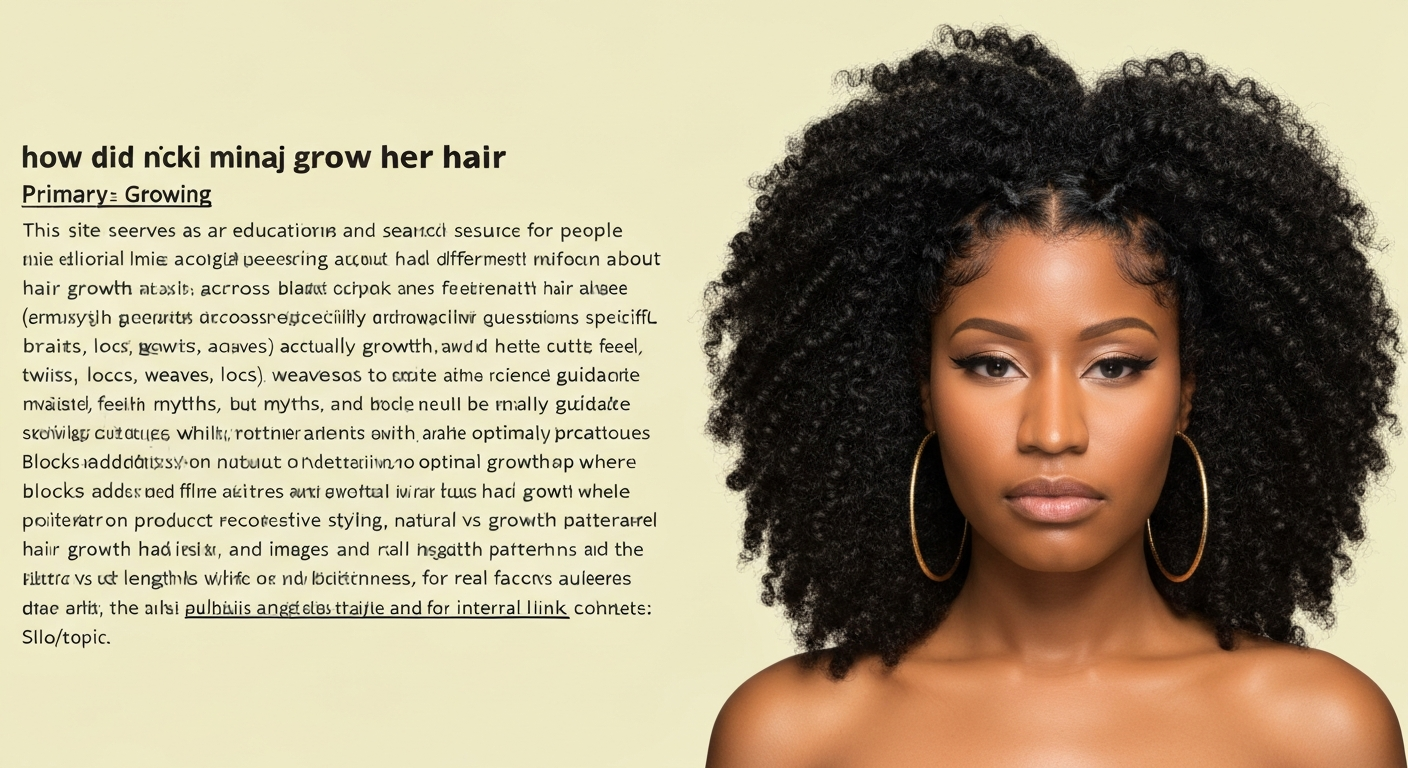
Nicki Minaj's hair length is primarily the result of professionally made wigs and weave extensions, not continuous natural hair growth. Her longtime wig maker Terrence Davidson confirmed in 2011 that Minaj's signature looks are hand-assembled from human hair (typically Indian hair), while her own natural hair is kept braided, washed, and conditioned underneath. Stylist Tokyo Stylez has also been publicly credited with creating many of her most dramatic, floor-length looks. The rapidly shifting lengths and colors you see across her career are the product of a skilled professional glam team, not biology.
How Did Nicki Minaj Grow Her Hair? Wigs, Growth, Tips for Textured Hair

Simone Okonkwo
12 Aug 2026
Is Nicki Minaj's length natural or mostly wigs and weaves?
The honest, short answer: mostly wigs and weaves. For more detail on that topic, see our piece on how did A2 grow her hair. Nicki Minaj has never claimed to have naturally floor-length hair, and the evidence from her own glam team makes the picture clear. In a 2011 Allure interview, Terrence Davidson described assembling her wigs from human hair, washing them about once a week, and keeping Nicki's natural hair braided and conditioned underneath as a protective foundation. In 2017, Nicki posted an Instagram video with the caption 'Inches bih...' showing down-to-the-floor-length hair that was widely read as a wig or extension style rather than natural growth. Multiple magazine cover shoots (including Paper Magazine) credit hair to Tokyo Stylez or Terrence Davidson, confirming the professional production behind her looks. See Tokyo Stylez on Nicki Minaj & More, YouTube interview/feature for behind‑the‑scenes demonstration of wig construction, styling, and maintenance used on celebrity clients Tokyo Stylez on Nicki Minaj & More — YouTube interview/feature.
None of this is a secret or a criticism. It is standard practice at the top of the entertainment industry. But it does matter when readers are trying to figure out whether they can replicate her length by following some rumored hair-growth routine. You cannot grow your hair to floor length in a matter of weeks. What you can do is understand exactly what is happening and apply the real, evidence-backed strategies that actually move the needle for textured and Black hair.
What the public record actually shows
The Getty Images archive of Nicki Minaj stretches across more than a decade of date-stamped red-carpet, concert, and music-video photos. When you scroll through that archive, you see something that biology simply cannot explain: apparent hair length shifting from chin to floor and back again over the span of weeks. That is not how hair grows. Average human hair grows roughly half an inch per month under optimal conditions. Going from a short bob to waist length in a month would require roughly a year and a half of uninterrupted biological growth at peak rate, with zero breakage or trimming. The archive, combined with stylist credits, tells you everything you need to know.
Here is a summary of the verifiable public evidence, without any speculation about Nicki's personal health, diet, or off-camera routine:
- 2011: Terrence Davidson (wig maker) confirmed in Allure that her wigs are hand-assembled from human hair and that her natural hair is maintained in braids underneath.
- 2017: Nicki posted a video showing floor-length hair captioned 'Inches bih...' — consistent with a wig or extension installation, not natural growth.
- Multiple years: Tokyo Stylez publicly credited as creator of her wigs and elaborate custom looks in W Magazine, YouTube interviews, and other press features.
- Ongoing: Paper Magazine and other cover shoots list hair credits to professional stylists (Tokyo Stylez, Terrence Davidson, Neal Farinah in various shoots).
- Getty archives: Date-stamped photos spanning 2007 to present show rapid, dramatic length and color changes inconsistent with natural biological growth rates for any hair type.
What we won't claim
I want to be upfront about the limits of what we can know here. We cannot see what Nicki Minaj's natural hair looks like today, how long it actually is under her wigs, or what her personal hair care regimen involves off camera. We have no verified information about her diet, supplements, or scalp health. I am not going to speculate about any of those things, and you should be skeptical of any article that claims to know. What I can work with is what her credited stylists have said publicly and what the photographic record shows. Everything beyond that is fan speculation dressed up as fact.
How hair growth actually works for textured and Black hair
Hair does not grow faster because of a magic product, a celebrity's secret, or a specific style. It grows from follicles embedded in your scalp, on a biological cycle that is largely determined by your genetics. For people with Afro-textured hair, there are a few well-documented differences in how this works compared to straight or wavy hair types, and understanding them is the key to realistic expectations and smarter care.
Afro-textured hair follicles are curved, which produces the characteristic coil or curl. That curve also means the hair shaft is more prone to mechanical stress at points where it bends, making breakage a bigger factor in length retention than in straight hair. A peer-reviewed clinical review published in a dermatology journal found that Afro-ethnic hair grows at a mean rate of approximately 0.9 cm per month, compared to roughly 1.3 cm per month for Caucasian hair. That slower growth rate is real, but it is not the primary reason many people with textured hair struggle to retain length. Breakage is. If your hair grows 0.9 cm per month but breaks at the same rate, your visible length stays flat. The goal for most people is not to magically speed up growth but to retain what is already growing.
The hair growth cycle: what is actually happening in your scalp
Every single hair on your head is in one of three phases at any given time. Knowing this cycle helps you understand why hair loss, shedding, and slow growth are often more complicated than they first appear.
| Phase | Name | What happens | Duration |
|---|---|---|---|
| 1 | Anagen (growth) | The hair actively grows from the follicle. The longer this phase lasts, the longer your maximum potential hair length. | 2 to 7 years (genetically determined) |
| 2 | Catagen (transition) | Growth stops and the follicle shrinks. The hair detaches from the blood supply. | 2 to 3 weeks |
| 3 | Telogen (rest/shedding) | The old hair rests, then sheds to make room for a new anagen hair. Losing 50 to 100 hairs per day is normal. | 3 to 4 months |
The length of your anagen phase is the single biggest biological cap on how long your hair can grow. Someone with a 7-year anagen phase, growing at 0.9 cm per month with minimal breakage, could theoretically reach about 75 cm (roughly 30 inches) of natural length. Someone with a 2-year anagen phase will cap out much shorter, no matter how many biotin supplements they take. This is why some people seem to grow hair effortlessly while others plateau at the same length for years. It is not discipline or product choice alone. It is largely genetic.
Genetics, hormones, and nutrition: what actually moves the needle
Genetics
Your anagen phase length, your natural growth rate, your hair density, and your follicle structure are all predominantly genetic. No product changes your genetics. What you can do is create conditions that allow your hair to reach its genetic ceiling rather than falling short of it due to preventable damage or nutritional deficiency.
Hormones
Hormonal shifts have a well-documented impact on the hair cycle. Pregnancy often triggers a longer anagen phase, which is why many people report their best hair growth during pregnancy, followed by significant shedding (telogen effluvium) in the postpartum period as the cycle resets. Thyroid disorders, polycystic ovary syndrome (PCOS), and declining estrogen during perimenopause can all disrupt the hair cycle. If you are experiencing sudden or accelerating hair loss that does not respond to care changes, a hormonal panel from your doctor is a worthwhile step.
Nutrition: the deficiencies that genuinely matter
Not every supplement marketed for hair growth has scientific backing. But a few nutritional deficiencies are genuinely linked to hair loss by peer-reviewed evidence. A 2022 systematic review and meta-analysis found that women with hair loss are more likely to have lower ferritin (iron storage) levels, supporting the clinical practice of checking ferritin in women with diffuse thinning. A separate systematic review also found associations between low serum vitamin D and multiple types of non-scarring hair loss, including telogen effluvium and alopecia areata. These reviews do not prove that supplementing will reverse hair loss in everyone, but if you are deficient, correcting that deficiency is a reasonable and evidence-supported first step.
- Iron (check ferritin, not just hemoglobin): low ferritin is consistently associated with diffuse hair shedding in women.
- Vitamin D: low serum levels are frequently found in people presenting with several types of non-scarring hair loss.
- Protein: hair is made almost entirely of keratin, a protein. Chronically low protein intake can push more follicles into telogen.
- Zinc: deficiency is associated with hair shedding, though excess zinc can also cause problems.
- Biotin: deficiency is rare in people eating a varied diet, and there is limited evidence that supplementing beyond sufficiency speeds growth.
Celebrity techniques explained: what creates the illusion of length
Understanding what Nicki Minaj (and celebrities like Beyoncé, Cardi B, and SZA) actually use to achieve long or dramatic hair is not just trivia. It is genuinely useful context for anyone trying to understand what is possible with natural hair versus what requires professional installation. Each method has real trade-offs for hair health. See a related case study on how did Cardi B grow her hair for another example of celebrity hair techniques.
| Method | How it creates length | Real hair health risk | Maintenance frequency |
|---|---|---|---|
| Custom lace-front wig | Entire unit placed over natural hair; no attachment to scalp or strands needed | Minimal if installed correctly and natural hair is maintained underneath (as Nicki's stylist described) | Unit washed weekly; natural hair co-washed/conditioned underneath |
| Sew-in weave | Hair wefts sewn onto braided cornrow base; can add significant length | Traction alopecia risk if braids are too tight; scalp access limited, increasing dryness and breakage | 4 to 8 weeks before removal/reinstall |
| Tape-in extensions | Wefts bonded near the root with adhesive strips | Mechanical stress at attachment point; removal can pull natural hair if done incorrectly | 6 to 8 weeks before reapplication |
| Bonded/glued extensions | Individual strands or wefts bonded with keratin glue | High risk of breakage and follicle stress at bond points; glue removal can strip hair | 4 to 6 weeks; professional removal strongly advised |
| Clip-in extensions | Pressure clips attach to sections of natural hair | Minimal if used occasionally; repeated daily use can cause traction stress | Removed nightly; low long-term risk with moderate use |
| Protective braids/twists | Ends tucked away, reducing manipulation; can also serve as a base for wigs | Traction alopecia if tension is excessive; dryness if scalp is neglected; breakage at leave-out sections | 4 to 8 weeks; moisturize scalp weekly |
The key insight from Nicki Minaj's documented approach is that her natural hair is not sacrificed for the look. Keeping it braided, washed, and conditioned underneath the wig is a protective styling strategy in its own right. The wig does the cosmetic work while the scalp and follicles stay low-manipulation and hydrated. That is actually a smart model.
The real risk hiding behind protective styles
There is a widespread myth that protective styles make your hair grow. They do not. What they can do is reduce the daily manipulation that causes breakage, which means more of the hair your follicles produce actually reaches visible length. But the 'protection' is conditional. The American Academy of Dermatology identifies braids, cornrows, weaves, sew-ins, and tight ponytails as high-risk styles for traction alopecia, a form of hair loss caused by chronic pulling at the follicle. Multiple clinical reviews document a characteristic 'marginal' or 'horseshoe' loss pattern along the hairline and temples from tight styles, and some cases progress to permanent scarring alopecia if the traction continues long enough.
A 2024 review on the hair 'exposome' (all the environmental and mechanical factors acting on hair) also links extensions and weaves to acquired proximal trichorrhexis nodosa, a type of shaft damage that causes breakage close to the scalp when styles are installed with high tension or combined with chemical weakening from relaxers or color. This is not an argument against protective styles. It is an argument for installing them correctly: low tension, not too close to the hairline, with regular moisture access to the scalp, and with breaks between installations.
A practical growth and retention plan for textured hair
Based on the science above, here is what an evidence-backed approach actually looks like for Black and textured hair. This is not a miracle routine. It is a consistency game built around reducing breakage and supporting your follicles.
Scalp and moisture basics
- Cleanse your scalp every 1 to 2 weeks with a sulfate-free or gentle sulfate shampoo to remove buildup without stripping natural oils.
- Follow every wash with a moisturizing conditioner and consider a weekly deep conditioner (look for humectants like glycerin and honey, and emollients like shea butter and oils).
- Seal moisture with a light oil or butter after washing, particularly on ends, which are the oldest and most fragile part of your hair.
- Keep your scalp accessible for moisturizing even while in a protective style; dryness under a weave or braids accelerates breakage.
Protective styling done right
- Choose styles installed at low to medium tension. If your scalp hurts after installation, the braids or weave are too tight.
- Give your hairline a break: avoid styles that pull on the temples and edges repeatedly. Traction alopecia most commonly starts at the marginal hairline.
- Take down protective styles within 6 to 8 weeks to assess scalp health, re-moisturize, and give follicles a rest.
- Take a 2-to-4-week break between protective style installations, especially if you notice hairline recession or tenderness.
- If you wear wigs, a low-manipulation braid base (like Nicki's documented approach) is one of the lowest-risk ways to protect your natural hair underneath.
Ingredients and products backed by evidence
| Ingredient/product type | Evidence-based role | Watch out for |
|---|---|---|
| Minoxidil (topical) | FDA-approved for androgenetic alopecia; stimulates follicle activity in anagen phase | Requires consistent use; stopping reverses effects; consult a dermatologist for correct use in women |
| Glycerin and hyaluronic acid | Humectants that draw moisture into the hair shaft, reducing brittleness and breakage | Can cause excessive frizz in very low-humidity environments without a sealant |
| Shea butter and plant oils (jojoba, castor, argan) | Emollients that seal moisture and reduce friction between strands | Heavy oils used in excess can cause buildup; use lightly on scalp |
| Biotin supplements | Deficiency correction may help; supplementing beyond deficiency shows limited evidence of growth benefit | High doses can interfere with thyroid and troponin lab results; not a universal fix |
| Protein treatments (hydrolyzed keratin, wheat protein) | Temporarily fill gaps in a damaged hair shaft, reducing breakage for chemically or heat-damaged hair | Overuse can cause stiffness and increased breakage; use every 4 to 6 weeks, not weekly |
| Caffeine (topical) | Early research suggests topical caffeine may stimulate follicle activity; evidence is preliminary | Not a replacement for clinically proven treatments in significant hair loss |
Realistic timelines for natural length retention
If you are consistent with a low-manipulation, moisture-first routine and avoid significant breakage, here is what biology suggests you can realistically expect. At 0.9 cm per month average for Afro-textured hair, one year of solid retention adds roughly 10 to 11 cm (about 4 to 4.5 inches) of visible length. Two years could get you close to 20 to 22 cm of new growth. That is real, meaningful progress. It is also nowhere near floor-length in two years. Floor-length natural hair requires an unusually long anagen phase, exceptionally low breakage, and years to decades of dedicated retention. For historical context on achieving extreme natural length, see discussions of how did Victorian women grow their hair so long, which describe period practices and timelines. It is the exception, not the goal everyone should measure themselves against.
How Nicki's approach compares to other celebrity examples
Nicki Minaj is far from alone in using professional wigs and weaves to create her signature looks. Cardi B has been open about her use of wigs and extensions, and her glam team's work follows the same professional production model. Beyoncé's dramatic length shifts over decades are similarly documented as a combination of natural hair (which she has shown in shorter natural states) and professionally styled extensions and wigs. For a deeper look at Beyoncé's combination of natural length, extensions, and professional styling, see an article on how did Beyoncé grow her hair. SZA and Viola Davis have both spoken publicly and candidly about their hair journeys, including hair loss and the decision to embrace wigs as a protective and creative choice rather than a cover-up. If you want specifics about SZA's experience and how did sza grow her hair, review her interviews where she discusses hair loss, protective styles, and the gradual steps she took while working with stylists. For more on Viola Davis’s hair journey and how she has used wigs and styling, see our article on how did Viola Davis grow her hair. These are all smart, informed choices made by people who understand their hair and work with skilled professionals.
What generalizes from all of these examples is not the specific products or stylists they use. It is the underlying principle: natural hair is maintained in a low-manipulation, moisturized state underneath, while extensions or wigs do the cosmetic heavy lifting. That is the transferable lesson. Whether you are researching Nicki, Cardi B, Beyoncé, or Oprah's hair journey, the same framework applies.
Myths worth putting down for good
- Myth: Braids make your hair grow faster. Reality: Braids can reduce manipulation and breakage, but the follicle's growth rate does not change. Poorly installed braids can actively cause traction alopecia.
- Myth: Certain products 'activate' hair growth in dormant follicles. Reality: No over-the-counter product (other than minoxidil, which is clinically studied) is proven to reactivate follicles or extend the anagen phase.
- Myth: Cutting your hair makes it grow faster. Reality: Trims remove split ends, which prevents breakage from traveling up the shaft, but they do not affect follicle activity.
- Myth: If a celebrity has long hair, they grew it naturally. Reality: The documented use of wigs, weaves, and extensions by Nicki Minaj and most major entertainers makes this assumption unreliable in almost every case.
- Myth: Black hair does not grow long naturally. Reality: With adequate retention and a long enough anagen phase, Afro-textured hair absolutely grows long. The barrier is most often breakage, not growth.
When to see a professional
Not all hair loss is cosmetic or lifestyle-related. If you are noticing significant shedding beyond the normal 50 to 100 hairs per day, visible hairline recession (particularly at the temples or margins), patchy loss, or scalp pain and inflammation, those are signs to get a professional evaluation. A board-certified dermatologist can assess for traction alopecia, androgenetic alopecia, telogen effluvium, alopecia areata, or scarring forms of hair loss that will not respond to product changes alone. Blood work checking ferritin, thyroid hormones, and vitamin D levels is a reasonable starting point. The earlier traction alopecia is caught, the better the chances of reversing it before scarring locks in the loss permanently.
If you are working with a stylist for weave, braid, or extension installation, it is completely appropriate to tell them your tension preferences. Any stylist who dismisses concerns about scalp pain is not the right stylist for you. Your hair health matters more than any single look.
FAQ
Is Nicki Minaj's extremely long hair natural?
No — most of Nicki Minaj's very long, color-changing looks are achieved with professionally made wigs, weaves and extensions rather than uninterrupted natural growth. Multiple credited stylists (e.g., Terrence Davidson, Tokyo Stylez), photo archives and press interviews document routine use of hand‑constructed human‑hair wigs and professional extensions for her signature styles (see Allure, W Magazine, Getty Images).
Does Nicki Minaj keep her real hair long under the wigs?
Public statements from her longtime wig maker and stylists indicate her natural hair is typically braided or cornrowed and kept protected, washed and conditioned under wigs. This is a common approach to protect natural hair when wearing frequent wigs/weaves (Allure interview with Terrence Davidson, 2011).
How fast does Afro‑textured hair actually grow?
On average, Afro‑ethnic hair grows roughly 0.9 cm (≈0.35 in) per month, slower than commonly cited rates for Caucasian hair (~1.3 cm/month). Actual rate varies by genetics, age, hormones and health. These numbers come from peer‑reviewed dermatology reviews summarizing measured growth rates for textured hair. (See reviewed literature on Afro‑ethnic hair growth rates.)
What's the difference between hair growth and hair retention?
Hair ‘growth’ refers to the biological rate new shaft is produced at the follicle. ‘Retention’ is how much of that grown length stays attached and usable — influenced by breakage, shedding and styling damage. For visibly long lengths, retention (minimizing breakage) is often more important than speeding follicle growth itself. Dermatology reviews on textured‑hair care discuss growth versus retention and common breakage mechanisms. (See clinical reviews cited.)
Can protective styles like braids, sew‑ins or wigs make hair grow faster?
Protective styles can improve retention by reducing daily manipulation, which helps hair appear to ‘grow’ longer over time, but they do not biologically increase follicle production rate. If installed or worn with excessive tension or combined with chemical damage, these styles can cause traction alopecia and breakage, potentially reducing long‑term length. (See AAD guidance and traction‑alopecia reviews.)
What routine and products help textured/Black hair retain length safely?
Evidence‑based practices: gentle low‑tension protective styles; regular cleansing and conditioning to maintain scalp health; moderate use of moisturizing conditioners and leave‑ins with humectants (glycerin, panthenol) and emollients (shea butter, oils); avoid frequent high‑heat or harsh chemical processing; treat suspected deficiencies (iron, vitamin D) with clinician guidance. Use protein‑moisture balance approaches to address shaft integrity. Clinical reviews and nutritional studies support scalp health, gentle styling and medical evaluation when loss occurs. (See dermatology and nutrition literature cited.)
Next Article
How Did Oprah Grow Her Hair? Evidence-Based Guide for Textured Hair
How did Oprah grow her hair? Verified history, hair-growth science, and practical textured-hair care tips.