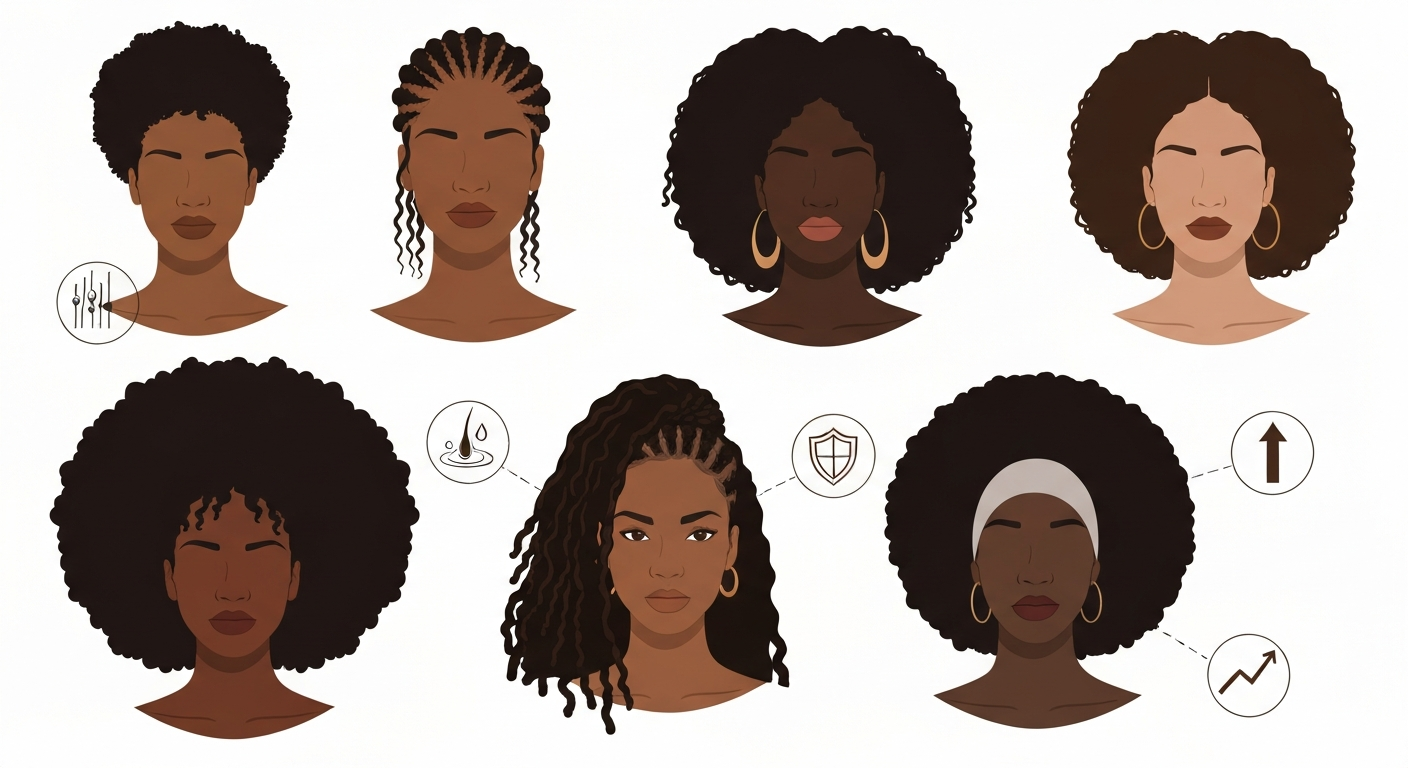
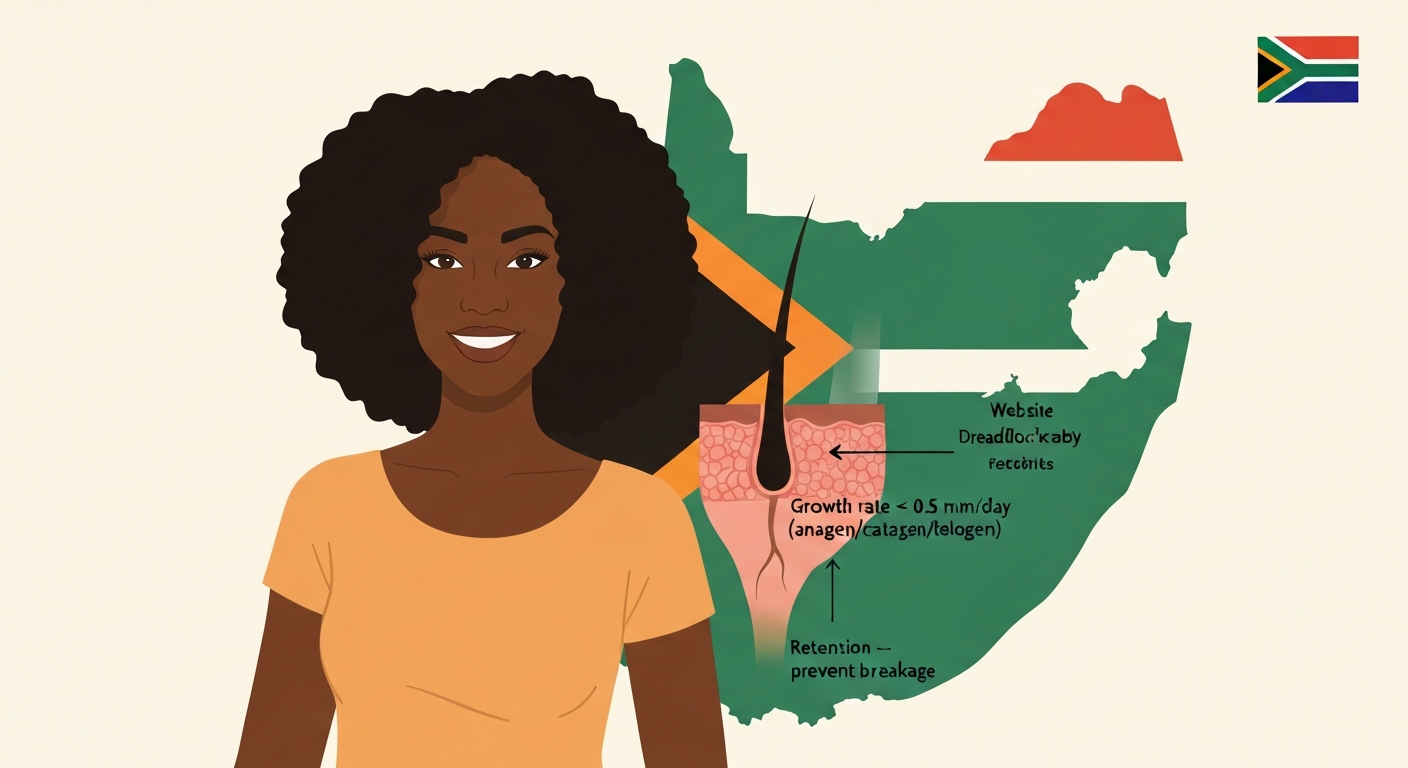
Your hair is already growing. At roughly 0.35 mm per day, your follicles are doing their job whether you do anything special or not. The real challenge with natural Black and textured hair in South Africa is not making it grow faster, it is stopping it from breaking off at the same rate it grows. That difference, between growth rate and retention, is the single most important concept in this entire guide, and once you understand it, most of the confusion around hair care falls away.
How to Grow Natural Hair South Africa: Science-Based Guide

Simone Okonkwo
13 Aug 2026
Who this guide is for and what you will actually learn
This article is written for anyone with Black or textured hair in South Africa who wants a realistic, evidence-backed plan for growing and keeping length. That includes people who are fully natural, those transitioning from relaxed hair, and those who have been protective styling without seeing the results they expected. You do not need a dermatology degree to follow this. I have pulled from peer-reviewed research in hair science and dermatology, filtered it through practical reality, and flagged where the science has gaps so you are not misled by false precision.
- How textured hair grows biologically and why retention (not growth rate) is what you should focus on
- Which styling choices genuinely protect length and which ones silently destroy it
- A realistic daily, weekly, and monthly hair care routine built for South African conditions
- Product ingredient guidance relevant to local shoppers, including what to look for and what to avoid
- Scalp care protocols, including oils, massage, and when a problem needs professional attention
- Clear signals for when to see a trichologist or dermatologist
How textured hair actually grows: the biology behind the curl
Hair grows in cycles: anagen (active growth), catagen (transition), and telogen (resting and shedding). On average, human scalp hair grows about 0.35 mm per day, which works out to roughly half an inch per month or six inches per year. Research consistently shows that Afro-textured hair has a higher proportion of follicles in the telogen (resting) phase compared to straight hair types, and measured linear growth tends to be slightly slower on average. This is biological, not a flaw, and it is not something any oil or supplement will fundamentally override.
The curl pattern itself is the other critical factor. Afro-textured hair grows from an elliptical, asymmetrically curved follicle, which produces a tightly coiled shaft. That coil is beautiful but it also means the natural curvature creates structural stress points along the strand. Each twist and bend is a potential site for breakage, especially when the hair is dry, manipulated frequently, or under tension. This is not a weakness unique to South African hair, it is the same biology discussed in research covering Nigerian, Kenyan, Ghanaian, and diaspora African hair. For practical, locally relevant tips on Nigerian textured hair, see naija hair can grow. See our detailed guide on how to grow Nigerian hair for practical, region-specific tips tailored to Afro-textured hair. The practical implications are largely universal, even if local climate and water conditions add a regional layer.
Growth rate versus length retention: why the distinction matters
Growth rate is what your follicle produces at the root. Retention is how much of that growth you keep before it breaks off at the ends. You can have perfectly healthy follicles producing new hair every single day while your ends snap off at the same pace, leaving you with the appearance of no growth at all. For practical tips on what can grow natural hair and how to improve retention, see our detailed guide. Dermatologists and trichologists studying African hair use tools like trichoscopy (dermoscopy of the scalp) and phototrichograms to distinguish between true follicular growth and surface-level breakage, because they are genuinely different problems with different solutions. Most people struggling with 'hair that won't grow' are actually dealing with a retention problem, not a growth problem.
Cultural context: styling is not the enemy of growth
South Africa has a rich and diverse hair culture. Box braids, cornrows, Bantu knots, twists, locs, and wigs carry cultural meaning, aesthetic identity, and practical function. None of them are inherently bad for your hair. The problem is not the style, it is the tension, the frequency of manipulation, and the duration of wear without maintenance. I want to be clear about this because there is a tendency in hair science content to present traditional African styling as dangerous and leave it there, which is both inaccurate and dismissive. When these styles are installed correctly and maintained thoughtfully, they are among the most effective tools for retaining length.
At the same time, the science does not give any style a free pass. Traction alopecia, hair loss caused by repeated tension on the follicle, is well documented in research specifically involving women who wear tight braids, cornrows, and weaves long-term. It starts as non-scarring and is often reversible if you catch it early and remove the tension source. But chronic traction over years can cause permanent follicular destruction. This is documented in multiple clinical reviews and it is a real risk, not a scare tactic. Honouring cultural practice means doing it in a way that keeps your hair and scalp healthy for decades.
Common myths debunked: what braids, locs, weaves, and relaxers actually do
Myth: protective styles make your hair grow faster
Braids, twists, and wigs do not stimulate the follicle to produce hair faster. What they do, when installed without excessive tension and maintained properly, is reduce daily manipulation and mechanical friction, which means less breakage at the mid-shaft and ends. The result is that you keep more of the length your follicles are already producing. That is retention, not accelerated growth, and it is a meaningful distinction because it changes how you measure success.
Myth: locs cause hair loss
Locs are one of the lowest-manipulation styles available. The concern is usually about the locking process itself (particularly freeform or interlocking methods with high tension at the base) and about the weight of mature locs pulling on follicles at the hairline. Well-maintained locs with appropriate weight management are not inherently damaging. The issue, again, is tension and neglect, not the style itself.
Myth: weaves prevent your natural hair from breathing and stop growth
The scalp does not 'breathe' the way lungs do, it receives oxygen from your bloodstream, not from the air. A weave installed on a clean scalp with proper tension does not suffocate follicles. The real risks are tension at the weft attachment points, product buildup under the weave, and extended wear without moisture maintenance underneath. Weaves worn for longer than eight weeks without being removed and the natural hair tended to set up conditions for breakage and scalp issues.
Relaxers, chemical straighteners, and the real trade-offs
This is where I need to be especially straightforward. Chemical relaxers alter the hair shaft's disulfide bonds permanently, making textured hair straight. Research documents a consistent pattern of increased breakage, follicular inflammation, and scalp burns when relaxers are used frequently or in combination with tight styles. There is also an evolving body of epidemiological research investigating associations between long-term use of certain chemical hair straightening products and risks of some hormone-sensitive cancers. The causal picture is not fully settled, but the documented harms, burns, inflammation, breakage, are well established. If you choose to use relaxers, longer intervals between applications, careful scalp protection, and avoiding overlap onto previously relaxed hair are the minimum precautions. Many South Africans are transitioning away from relaxers for exactly these reasons, and this guide fully supports that choice.
Your step-by-step hair care routine: daily, weekly, and monthly
Daily habits
Daily care for natural textured hair is mostly about moisture maintenance and low manipulation. In South Africa, especially in drier inland cities like Johannesburg or Pretoria, the climate pulls moisture from the hair quickly. In coastal cities like Durban or Cape Town, humidity helps but also encourages product build-up. Every morning, your job is to re-seal moisture, not to start from scratch. A light water-based leave-in or a few spritzes of water followed by a cream or oil sealant is enough. The LOC or LCO method (Liquid, Oil or Cream, then the remaining) works well for most textured hair types, experiment to find which order your hair responds to. Avoid heavy manipulation when dry. If you need to detangle, do it with a wide-tooth comb or fingers on wet, conditioned hair only.
Weekly routine
Once a week, you should be washing or co-washing, conditioning, and deep conditioning. For most natural hair types, a sulfate-free shampoo or co-wash (conditioner-only wash) works well for regular cleansing between clarifying sessions. Co-washing hydrates dry or coily hair and maintains the scalp's moisture without the stripping effect of sulfates. However, you must clarify with a sulfate-containing shampoo every three to four weeks (or sooner if you use heavy products or dry shampoo) to remove mineral buildup, silicone residue, and sebum accumulation. South African municipal tap water in many areas is hard water, which means higher mineral content that deposits on the hair shaft and scalp, this makes clarifying even more important here than in regions with softer water.
Deep conditioning follows every wash. Use a moisturizing deep conditioner as your default. If your hair shows signs of over-elasticity (stretches a lot before breaking, feels mushy when wet), introduce a protein treatment every three to four weeks. If it snaps immediately with little stretch, prioritize moisture. This protein-moisture balance is individually calibrated, there is no universal schedule because porosity, damage history, and styling habits all vary.
Monthly routine
Monthly, assess your ends. If you see splits, whitish tips, or single-strand knots clustering heavily, it is time to dust (trim a tiny amount) or do a light trim. For most people with healthy textured hair, trimming or dusting every three to four months is sufficient to prevent split propagation. Trimming does not make hair grow faster, that is a myth, but it prevents splits from traveling up the shaft and causing you to lose far more length in a later, bigger trim. Also monthly, do a scalp check: look for flaking, redness, tender spots, or thinning areas, particularly at the hairline and temples. These are your early warning zones.
Sample weekly and monthly maintenance schedule
| Frequency | Task | Products/Tools | Notes |
|---|---|---|---|
| Daily | Moisture refresh and seal | Water-based leave-in, lightweight oil or cream | Use LOC or LCO method; avoid heavy manipulation on dry hair |
| Daily | Protective styling/low manipulation | Satin/silk bonnet or pillowcase at night | Reduces friction breakage overnight |
| Weekly | Co-wash or sulfate-free shampoo | Sulfate-free shampoo or cleansing conditioner | For most coily hair types; adjust if scalp is oily |
| Weekly | Deep condition | Moisturizing deep conditioner with heat (optional) | 20–30 min under hooded dryer or steamer boosts penetration |
| Weekly | Detangle | Wide-tooth comb or fingers, detangling conditioner | Always on wet, conditioned hair; work from ends to roots |
| Every 3–4 weeks | Clarifying wash | Sulfate shampoo or apple cider vinegar rinse | Removes mineral deposits, silicone buildup, and sebum; important with hard water |
| Every 3–4 weeks | Protein treatment (if needed) | Hydrolyzed protein mask or treatment | Only if hair is over-elastic or breaking; avoid overuse |
| Every 3–4 months | Trim or dust ends | Sharp hair scissors only (not regular scissors) | Prevents split propagation; does not accelerate growth |
| Monthly | Scalp check | Mirror, good lighting | Look for redness, tenderness, recession, scaling at hairline and temples |
| Monthly | Protective style assessment | N/A | Reassess tension, product buildup, and style age; remove if older than 6–8 weeks |
Scalp care: the foundation everything else is built on
A healthy scalp is a prerequisite for healthy hair. You cannot build retention on a neglected or inflamed scalp. Scalp care for natural textured hair in South Africa involves keeping the scalp clean, moisturized without being over-oiled, and stimulated. Here is what the evidence actually supports.
Scalp massage
Regular scalp massage increases blood circulation to the follicle area, which supports the delivery of nutrients to hair roots. A small Japanese clinical study showed increased hair thickness after daily standardized scalp massage over 24 weeks. The quality of evidence is not yet high enough to make strong prescriptive claims, but the mechanism is plausible and the risk is essentially zero. Five to ten minutes of fingertip massage during washing or with a scalp tool two to three times a week is a reasonable practice. Do this with clean hands on a clean scalp, massaging product-laden or dirty hair deeper into follicles is counterproductive.
Oils: which ones actually help
Not all oils work the same way on hair. The best-studied oil for textured hair is coconut oil, which has demonstrated actual shaft penetration in bench studies, it reduces protein loss from the hair strand. Rele & Mohile (1999/2003) found that coconut oil penetrates the hair shaft and reduces protein loss, whereas mineral and sunflower oils showed less shaft penetration and protection Rele & Mohile (1999/2003) found that coconut oil penetrates the hair shaft and reduces protein loss.. Sunflower oil and mineral oil have shown less penetration in the same comparative research. This does not mean coconut oil is a miracle treatment, but it does have more scientific backing as a pre-wash treatment (applied before shampooing to reduce hygral fatigue and protein loss) than most other oils. For the scalp specifically, lightweight oils like jojoba oil closely mimic sebum and absorb well without heavy buildup. Avoid applying thick, heavy oils like castor oil directly to the scalp in large quantities, it has a place as a targeted hairline treatment but is too heavy for general scalp application and can clog follicles or trap debris.
South African shoppers can find coconut oil and jojoba oil at Clicks, Dis-Chem, and Checkers nationwide, as well as from local suppliers at lower prices. For leave-ins and deep conditioners, local brands like African Extracts Rooibos Hair Care and Inecto Naturals offer affordable, widely available options. When reading ingredient lists, look for humectants like glycerin and aloe vera near the top (they draw moisture into the shaft), emollients like shea butter and plant oils (they soften), and occlusives that seal (heavier butters and oils). Avoid products that list mineral oil or petrolatum as the second or third ingredient, as these sit on top of the shaft without moisturizing and can cause significant product buildup.
Common scalp issues and home treatments
Dandruff (seborrheic dermatitis) is one of the most common scalp complaints in South Africa. It is a fungal-related condition and it does not mean your scalp is dry, it often means the opposite. Zinc pyrithione shampoos (like Head and Shoulders) and ketoconazole shampoos (available over the counter at Clicks and Dis-Chem) are clinically effective for mild to moderate seborrheic dermatitis. Tea tree oil has some antimicrobial evidence in small studies, but it should be diluted before application to the scalp, undiluted tea tree oil causes contact dermatitis in some people. For dry scalp (distinct from dandruff), the fix is more moisture: a scalp serum or lightweight oil applied after washing, not before.
When to stop home treatment and see a professional
Some scalp and hair loss conditions look like common problems but require clinical diagnosis and intervention. Do not continue to manage these at home. See a dermatologist or trichologist if you notice any of the following: Clinical red flags for specialist referral include persistent or painful pustules or crusting on the scalp, rapidly progressive hairline recession, a shiny/atrophic (scarred) scalp, failure to improve after conservative de‑tensioning, or diagnostic uncertainty, scalp biopsy or trichoscopy may be indicated (see Traction alopecia: the root of the problem (PMC review)).
- Painful or persistent pustules (pus-filled bumps) or crusting on the scalp
- Rapidly progressive hairline recession — especially at the temples and frontal hairline — that is not slowing down after removing tight styles
- A shiny, smooth patch on the scalp where hair used to grow (this can indicate scarring alopecia, which destroys follicles permanently if untreated)
- No improvement in traction-related thinning after 3 to 6 months of completely removing the tension source
- Significant hair shedding that persists for more than 3 months without an obvious cause like postpartum changes or illness
- Any scalp condition that causes pain, burning, or significant disruption to daily life
In a clinical setting, trichoscopy (dermoscopy applied to the scalp) allows a dermatologist to assess follicular health, distinguish traction alopecia from other forms of hair loss, and determine whether scarring has occurred, all without invasive procedures. A scalp biopsy may be indicated if scarring alopecia is suspected. South Africa has trained dermatologists in all major cities (Johannesburg, Cape Town, Durban, Pretoria) who can assess these conditions. Trichologists with specific hair and scalp training are also available, particularly in major urban centres, though their training credentials vary more widely than medical dermatologists, look for someone affiliated with a recognized professional body.
Regional factors: South Africa versus other African contexts
Much of the hair growth guidance circulating online originates from North America or the UK and is then applied globally without adjustment. A few South African-specific factors are worth noting. Hard water is common in many South African municipalities, particularly in Gauteng, and causes mineral deposits (mainly calcium and magnesium) to build up on the hair shaft, making it stiff, dull, and harder to moisturize. Regular clarifying washes (and optionally, a diluted apple cider vinegar rinse before conditioning) help manage this. The dry Highveld winter strips moisture from hair faster than a coastal environment does, which means your sealing step is more critical in Johannesburg in July than in Durban in the same month.
If you have also read guidance aimed at Nigerian or West African hair (topics covered in related content on this site around growing natural hair in Nigeria and maximizing virgin hair health), you will notice most of the biology overlaps almost entirely. Afro-textured hair shares the same growth mechanics across the continent. The differences are primarily environmental (climate, water quality) and product availability. The principles of moisture retention, low manipulation, protective styling with appropriate tension, and scalp health are consistent whether you are in Lagos, Nairobi, or Cape Town. For a practical, country-specific guide on how to grow virgin hair in Nigeria, consult the Nigeria hair-growth guide for local product recommendations and climate-adapted routines.
How to choose products as a South African shopper
You do not need expensive imported products to grow and retain healthy natural hair. South Africa has a growing local natural hair care industry, and accessible options are widely available. Here is a practical ingredient-focused framework for evaluating what you buy, regardless of brand.
| Product Type | What to Look For | What to Avoid | Where to Buy in South Africa |
|---|---|---|---|
| Shampoo (clarifying) | Sodium lauryl/laureth sulfate as the active cleanser; occasional use only | Using sulfate shampoos every wash day on dry coily hair | Clicks, Dis-Chem, Shoprite, Pick n Pay |
| Shampoo (regular wash day) | Sulfate-free surfactants: sodium cocoyl isethionate, decyl glucoside | Silicones high on the ingredient list if you are co-washing only | Clicks, Dis-Chem, local natural hair stores |
| Leave-in conditioner | Water as first ingredient; glycerin, aloe vera, panthenol | Mineral oil or petrolatum in top 3 ingredients | Clicks, Dis-Chem; African Extracts, Inecto Naturals locally |
| Deep conditioner (moisture) | Shea butter, fatty alcohols (cetyl/stearyl), hydrolyzed protein if mildly damaged | Products with mostly fragrance and water; no real conditioning agents | Clicks, Dis-Chem, Takealot |
| Sealant oil | Coconut oil (shaft penetration), jojoba oil (scalp use) | Petroleum-based products as your primary moisturizer | Clicks, Dis-Chem, Checkers, local markets |
| Scalp treatment | Zinc pyrithione or ketoconazole for dandruff; lightweight carrier oils for dry scalp | Undiluted essential oils directly on the scalp; very heavy grease | Clicks, Dis-Chem (OTC antifungal shampoos available) |
Troubleshooting: matching problems to solutions
If your hair is not retaining length despite consistent care, work through this framework before assuming a product change will fix everything. First, audit your tension: are any of your styles pulling at the hairline or scalp? If yes, that is your first change. Second, assess moisture: does your hair feel dry and snap easily? Prioritize moisturizing deep conditioning and more frequent re-moisturizing. Third, assess protein: does your hair feel limp, stretch a lot, and feel mushy when wet? Add a protein treatment and reduce heavy moisture application for a few weeks. Fourth, look at your manipulation frequency: are you combing, pulling, or re-styling daily? More protective time in a low-manipulation style will directly affect your retention. Fifth, consider your water and product buildup: when did you last clarify? If you cannot remember, do it now.
Most retention problems in natural textured hair fall into one of these five categories. Solving the right category is more effective than adding more products to an already-complex routine. Simplicity, consistency, and the right fundamentals outperform complicated multi-step regimens almost every time.
FAQ
What is the difference between hair growth rate and length retention for textured hair?
Growth rate is how fast the follicle produces new hair (average ~0.35 mm/day or ~6 inches/year for humans). Length retention is how much of that grown hair survives without breaking. For Afro‑textured hair, measured linear growth can be slower and the hair shaft is more prone to breakage, so improving retention (damage control, reduced manipulation, moisture/protein balance) is often more effective for visible length gains than trying to change follicle output.
Do braids, twists, locs, weaves or relaxers make hair ‘stop growing’ or damage the follicle permanently?
None of these styles inherently stop follicular growth. However, high tension, heavy extensions, repeated tight installations, or chemical relaxers that cause burns/inflammation can damage follicles and cause traction alopecia. Protective styles that minimize manipulation and tension help retention, but must be installed and maintained gently and not left indefinitely. Chemical straighteners can increase breakage and inflammation; their risks are dose‑ and practice‑dependent.
What is a practical daily, weekly and monthly routine for growing and retaining natural hair?
Daily: gentle moisturizing (light water‑based mist + sealant like oil/butter), low‑manipulation styling, night protection (silk/satin scarf or bonnet). Weekly: cleanse as needed (co‑wash or sulfate‑free shampoo depending on buildup), apply conditioner, detangle gently with fingers or wide-tooth comb when wet/conditioned. Every 2–4 weeks: deep‑condition or protein‑moisture treatment tailored to porosity. Monthly to 3‑monthly: clarifying wash if product/mineral buildup; trim or ‘dust’ split ends every ~3–4 months depending on damage; reassess protective styles and reduce tension.
How do I know whether my hair needs protein or moisture?
Do a simple elasticity test: wet a single stretched strand—if it stretches and returns, moisture is likely the priority; if it feels gummy, limp, or breaks easily, it may need protein. Highly porous or chemically damaged hair generally benefits from periodic hydrolyzed protein treatments to restore tensile strength; low‑porosity coarse hair often needs more moisturizing emollients and humectants. Alternate treatments and monitor: too much protein can make hair brittle.
Which ingredients should I look for or avoid when shopping for textured hair products in South Africa?
Look for: humectants (glycerin, propanediol), emollients (vegetable oils like coconut, sunflower; shea butter), occlusives (caprylic/capric triglyceride, petrolatum sparingly), hydrolyzed proteins (keratin, wheat, silk) for damaged hair, mild surfactants in sulfate‑free cleansers, and moisturizing conditioners. Avoid or use cautiously: frequent harsh sulfates if hair is very dry, overly heavy non‑water‑soluble silicones without a clarifying routine, and repeated application of high‑pH relaxers or products that cause scalp irritation. Coconut oil can reduce protein loss; mineral oil and some heavy silicones can build up.
Where can I buy recommended products in South Africa and which local brands are good?
Major retailers: Clicks, Dis‑Chem, Woolworths, Spar, and online stores (Faithful to Nature, Takealot) stock a wide range. South African and locally popular brands to consider include: Taliah Waajid (available specialty), Shea Moisture (widely stocked), Afrosheen/African Pride lines, local naturals and indie brands sold via Takealot and local boutiques. Compare ingredient lists and choose products matched to porosity and needs; ask retailers for product ingredient panels if needed.
Next Article
What Can Grow Natural Hair: Evidence-Based Guide for Naija
Evidence-based guide: what can grow natural hair for Black/texture hair, scalp care, protective styles, products