
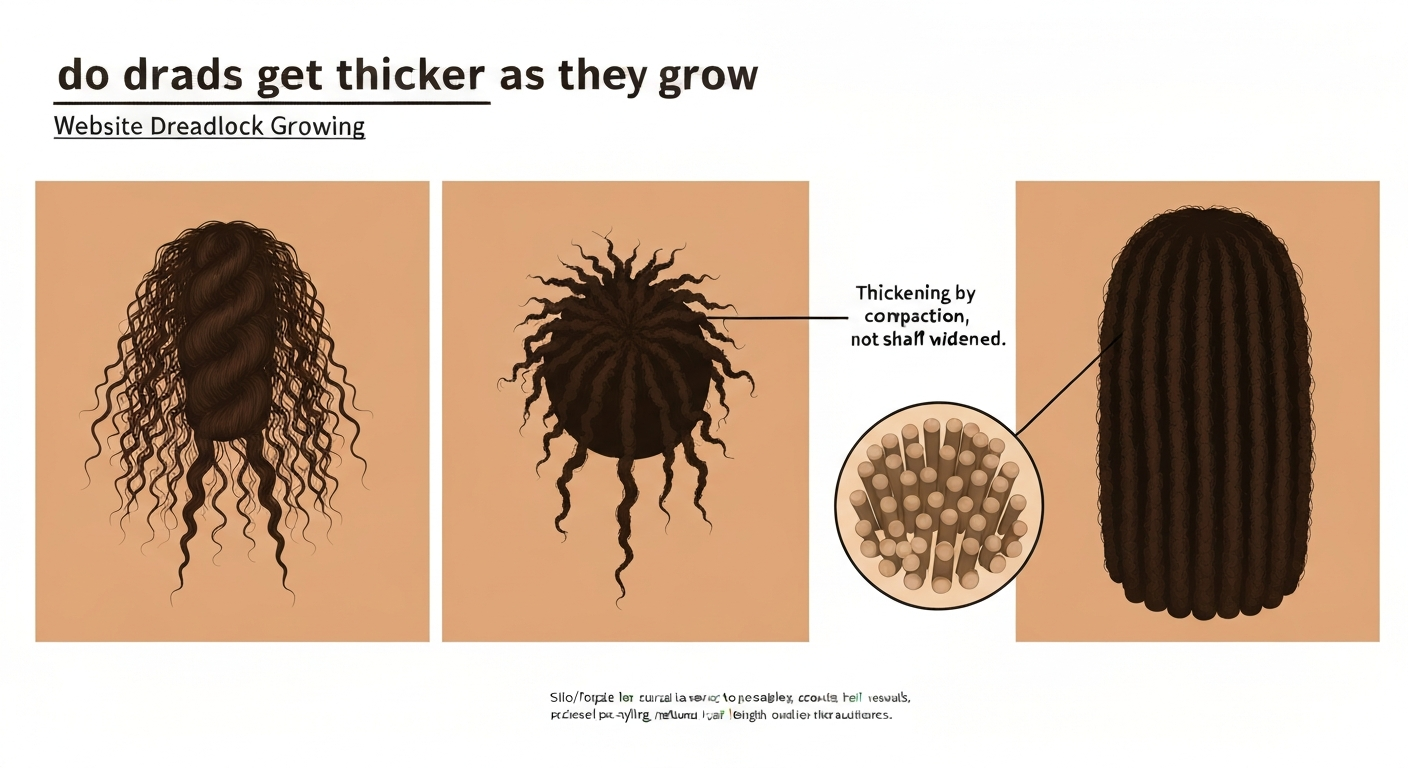
Yes, dreads do get thicker as they grow, but not in the way most people assume. The individual hairs in your locs do not widen at the follicle. What actually happens is that more hairs from each section entangle, compact, and fuse into a denser bundle over time, making the loc's overall circumference visibly larger. That process, driven by your hair's curl pattern, friction between strands, wetting and drying cycles, and how you maintain your roots, is what creates the thickness you see. Understanding the difference between a wider hair shaft and a more compacted loc matters because it changes how you care for your locs and what you can realistically expect at each stage.
Do Dreads Get Thicker as They Grow? Science-Based Guide

Simone Okonkwo
16 Jul 2026
The hair biology behind loc thickness
Before diving into locs specifically, it helps to understand what determines thickness at the strand level. Each hair shaft grows from a follicle, and the diameter of that shaft is set by the size and activity of the dermal papilla, a cluster of specialized cells at the follicle's base. Your genetics largely determine how large your dermal papilla is, which is why some people naturally produce thick, coarse strands and others grow fine ones. Hair that is already growing from your scalp cannot become measurably wider just because it gets longer. Length and diameter are separate outputs of follicle biology.
Average scalp hair grows roughly 0.3 to 0.35 mm per day, which works out to about 1 cm (just under half an inch) per month. That number does not change the fiber's cross-sectional diameter. What it does do is add more length that can entangle with neighboring hairs. For loc formation, this distinction matters: your locs are not growing thicker because each strand is fattening up. They are growing thicker because more length means more surface area available for permanent tangling and compaction.
Two other things affect the total density of hair in a given section: hair count per square centimeter (follicular density) and whether follicles are actively in anagen (the growth phase). People with higher follicular density and longer anagen phases naturally have more raw material to pack into each loc, which tends to produce fuller-looking, more substantial locs over time. Neither of these is something you can dramatically change through styling alone, but you can absolutely protect what you have.
How locs actually form and grow
A loc is essentially a long-term, intentional felting of hair fibers within a defined section. The physics behind it are the same forces that cause hair to mat in other contexts: fiber curvature (how tightly your hair coils), inter-fiber friction (how much the cuticles of neighboring strands grip each other), and repeated mechanical agitation combined with wetting and drying cycles. When these forces are sustained over time in a defined section, hairs interlock permanently rather than shedding cleanly away from each other. That is felting, and it is what a loc fundamentally is.
Afro-textured hair has a significant mechanical advantage here. Tighter curl curvature means more contact points between neighboring fibers per centimeter of length, and that raises the probability of permanent interlocking at every contact point. This is why 4C hair can begin showing loc budding within a few months, while straighter hair types may take a year or longer to form stable locs using the same maintenance approach. It is also why freeform loc journeys look and behave very differently depending on hair type. For anyone wondering whether locs can form without a stylist or structured starter method, the answer is yes for many naturally coiled textures, though the path looks different from a salon-started set. If you're asking whether dreads can grow naturally, see can dreads grow naturally for a concise explanation.
Why your locs look thicker over time (it's mostly compaction)
Here is the part that surprises most new loc wearers: a huge portion of the visible thickening you see in the first one to two years is not from new growth adding volume. It comes from the hairs already inside the loc packing more tightly together as the interior matures and densifies. In the early months, a loc is loosely structured and airy. As felting progresses, that same bundle of hairs compacts into a firmer, denser core. The circumference of a well-matured loc is often noticeably larger than the same section was at install, even accounting for the shrinkage that happens during the locking process.
Shrinkage compounds this illusion in an interesting way. Highly textured hair can shrink to as little as 25 to 30 percent of its stretched length. As a fresh loc is established, it initially appears shorter and sometimes thinner than expected because the curl pattern is still contracting the internal structure. Then, as locs mature and the internal fiber network locks into place, that shrinkage stabilizes, the loc stops coiling back on itself, and you are left with a denser, more uniform structure that looks and feels substantially thicker than a loose twist of the same hair ever did.
What does not cause thickening: applying heavy products hoping to bulk up the shaft, or any styling technique that claims to permanently widen the individual hair fiber. The only reliable path to individually fatter strands is genetics, managing hormonal or nutritional factors that may be suppressing follicle output, or in some cases scalp health interventions that bring an underperforming follicle back to its natural potential.
Starter methods and how they shape thickness from day one
The method used to start locs sets the baseline diameter you are working with for the entire journey. Section size is the single biggest variable you can control before locking begins. Larger sections produce thicker locs. Smaller sections produce finer ones. That said, each method also has its own mechanical character that influences how uniformly the loc matures and whether it holds its shape long-term.
| Starter Method | Initial Thickness | Locking Speed | Long-Term Shape | Key Consideration |
|---|---|---|---|---|
| Freeform / Neglect | Variable, often thick | Fast for coily types | Organic, irregular | Locs may congeal if not separated early |
| Two-Strand Twists | Medium to thick | Moderate | Rounded, uniform | Very popular for 4A–4C; good control over section size |
| Braids | Medium to thick | Moderate | Flat initial shape that rounds over time | Can leave braid pattern visible early on |
| Palm Rolling | Medium | Moderate | Cylindrical, tidy | Requires consistent upkeep to maintain shape |
| Twist and Rip | Medium to thick | Moderate to fast | Rougher early texture | Works well on straighter textures that resist coil-locking |
| Interlocking | Medium to thin | Moderate | Firm, tight | Tight grid pattern; risk of thinning at roots if over-done |
| Crochet Method | Medium | Fast appearance of maturity | Compact, neat | Mechanical manipulation; monitor for breakage at hook sites |
If thickness is your primary goal, starting with larger sections and a method like two-strand twists or freeform gives you the most raw material to work with. Micro-locs and sisterlocks, by contrast, are intentionally fine and will remain that way regardless of how long you grow them, because the section itself limits how much hair is available to compact. There is nothing wrong with either approach, but it is worth being honest with yourself about your goals before installation day.
Maintenance methods and their real effect on thickness
How you maintain your locs after they are started has a direct effect on how thick they stay, whether they thin out over time, and whether you retain the length you are growing. This is one of the most misunderstood areas of loc care, partly because the same technique applied at different frequencies or tensions can have opposite effects.
Retwisting
Retwisting is the most common maintenance method for two-strand twist starter locs and coily textures. Done every four to eight weeks at a comfortable tension, it keeps the root area neat and encourages the new growth to integrate into the existing loc structure. Done too frequently (every one to two weeks) or too tightly, retwisting puts sustained traction on the follicle. Dermatology research is clear that prolonged or repeated tension can cause traction alopecia, a form of hair loss that starts with follicular inflammation and can become permanent. Thinning at the roots, particularly near the temples and nape, is the earliest warning sign.
Palm rolling
Palm rolling compresses and shapes the loc body into a cylindrical form. It can temporarily firm up a loose or fluffy loc and give a more uniform appearance. Regular palm rolling on its own does not significantly accelerate internal compaction, but it does encourage a consistent external shape. Over-rolling on wet hair, especially with heavy products, can promote product buildup inside the loc, which eventually weakens the internal fiber structure rather than strengthening it.
Interlocking
Interlocking uses a tool (a latch hook or a rat-tail comb) to pull the loc tip through the root growth in a grid pattern. It is popular because it holds longer between appointments and works well for active lifestyles or thinner hair types. However, the mechanical stress is concentrated at specific rotation points inside the loc. Done too often or pulled too tightly, interlocking can create weak spots at those rotation sites, gradually thinning the loc from the inside out. Many stylists recommend interlocking no more than every eight to twelve weeks.
Crochet maintenance
Crochet hooks can tuck loose hairs into the loc body quickly, giving a more polished appearance and pulling frizzy new growth into the existing structure. The concern is that a fine crochet hook inserted repeatedly into the same sections can cut or weaken fibers, creating microbreakage that, over time, reduces the total fiber count inside the loc. This does not mean crochet is off-limits, but it is worth being selective about when and how often it is used.
Freeform / neglect method
Freeform locs involve minimal to no deliberate manipulation. Hairs are allowed to mat and combine based on their natural affinity for each other. For highly coiled textures, this often produces thick, organic-looking locs over time, though the section sizes and shapes will be uneven. The trade-off is that adjacent locs can combine (congeal), especially in early stages, which is why freeform journeys still require periodic separation to prevent one giant loc forming at the scalp.
What to expect at each stage of maturation
Loc maturation follows a fairly predictable arc, though the exact timing shifts based on hair texture, starter method, and maintenance frequency. Here is a realistic picture of what each stage looks like and when to expect it.
| Stage | Approximate Timeline | What It Looks Like | Thickness Change |
|---|---|---|---|
| Newborn / Starter | 0–3 months | Fresh twists, braids, or coils; loose and soft; may unravel | Baseline diameter; minimal compaction |
| Budding | 3–6 months | Frizzy texture; visible matting at mid-shaft; hair resists unraveling | Begins to feel denser; slight circumference increase |
| Teen | 6–12 months | Significant frizz and swelling; locs look puffy; most movement at new growth | Noticeable thickening from compaction; locs may appear uneven |
| Mature | 12–24 months | Locs firm up; smooth(er) outer layer; clear cylindrical shape | Peak compaction; thickest relative to starter diameter; stable circumference |
| Rooted / Established | 24+ months | Strong, flexible, fully locked from root to tip; low maintenance | Circumference stabilizes; length growth becomes the dominant visible change |
The teen stage, roughly six to twelve months in, is the phase that catches many people off guard. Locs look their messiest and most unruly at this point. The interior is actively felting, which causes swelling and irregularity. This is not a sign something is wrong. It is the compaction process doing exactly what it is supposed to do. Patience and consistent, low-manipulation care are the only things that move you through it.
For 4C hair specifically, the budding stage often arrives earlier (sometimes as soon as six to ten weeks) because of the tighter curl pattern and higher inter-fiber friction. For hair that is less coily or for locs started on relaxed hair, budding may take four to six months or longer, and the compaction process overall tends to be slower and sometimes produces a less dense final result.
Evidence-based factors that actually influence how fast locs grow
Growth rate and thickness are related but distinct. Your locs grow longer because your scalp is producing new hair, and that rate is governed by biology more than products or styling choices. That said, several factors genuinely influence how much of that growth you retain and how healthy your follicles are performing. For a concise guide on what makes dreads grow faster, see this overview.
Genetics and hair type
Your baseline growth rate is largely genetic. Some people's follicles spend more time in the anagen (active growth) phase, producing longer, more robust hair. Others cycle through anagen more quickly. You cannot override genetics entirely, but you can ensure your follicles are performing at their genetic ceiling rather than being suppressed by avoidable factors.
Scalp health
A healthy scalp means adequate blood flow, a balanced microbiome, and follicles free from chronic inflammation. Seborrheic dermatitis, scalp psoriasis, and product buildup all compromise the follicular environment. For loc wearers, buildup is a particular concern because the loc structure traps residue that would rinse away more easily from loose hair. I recommend clarifying with a residue-free or diluted apple cider vinegar rinse every four to eight weeks, depending on how often you use leave-ins or oils.
Tension and manipulation
Chronic tension is one of the most preventable causes of thinning in loc wearers. Traction alopecia is well-documented in dermatology and disproportionately affects people with Afro-textured hair who wear protective styles. The early signs are tenderness, small pimples or folliculitis around the hairline, and fine or sparse new growth in previously fuller areas. If you notice these signs, reduce tension immediately. Caught early, traction alopecia can reverse. Left untreated, follicular scarring can become permanent.
Nutrition
Iron deficiency is one of the most evidence-backed nutritional causes of diffuse hair thinning and shedding. Dermatology reviews consistently recommend checking serum ferritin in anyone experiencing unexplained diffuse shedding, particularly women of reproductive age, because low iron can suppress hair shaft caliber and push follicles prematurely into the resting phase. Vitamin D receptor activity is also essential for normal follicle cycling in experimental models. If your locs seem to be thinning or growing slowly without an obvious cause, getting a blood panel that includes ferritin and vitamin D levels is a reasonable first step.
On the supplement side, biotin is worth addressing directly because it is heavily marketed to loc wearers. Systematic reviews have found weak to no evidence that biotin supplementation improves hair growth or shaft diameter in people without a documented biotin deficiency. A systematic review, "Effectiveness of Biotin Supplementation for Hair Growth in Patients with Alopecia: A Systematic Review", concluded biotin improves hair only in cases of frank biotin deficiency and found weak or no high‑quality evidence that biotin benefits hair growth or shaft diameter in non‑deficient individuals. If you are not deficient, taking more biotin will not thicken your locs. A balanced diet with adequate protein (hair is made of keratin, which requires amino acids), iron, zinc, and vitamins A, C, and D supports follicle health more reliably than any single supplement.
Breakage vs. growth
Locs can grow at a perfectly normal rate and still fail to get longer if breakage is happening at a comparable rate. Inside a loc, breakage is not always visible the way it is with loose hair. Signs include thinning at specific points along the loc shaft (sometimes called weak spots or 'coning'), a loc that feels noticeably thinner in the middle than at the base or tip, and excessive shedding of short fiber fragments when the loc is manipulated. Heavy product buildup, over-manipulation, and tight interlocking are the most common causes of this kind of internal breakage.
Practical care to support thickness and retention
Most of what keeps locs thick and healthy comes down to a few consistent habits rather than any single product or technique. Here is what I have found actually moves the needle:
- Wash every one to two weeks using a residue-free, sulfate-free shampoo or diluted castile soap. Clean locs are healthier locs, and the belief that washing causes unraveling is largely a myth for locs past the budding stage.
- Dry locs thoroughly after washing. Damp locs left bundled or covered promote mildew growth inside the core, which weakens the fiber structure over time. A hooded dryer, blow dryer on low heat, or simply enough time in open air is necessary.
- Use lightweight oils sparingly. Heavy butters and thick creams build up inside the loc and do not penetrate the shaft anyway. A few drops of jojoba, argan, or grapeseed oil massaged into the scalp is sufficient for moisture support.
- Massage the scalp regularly. Even two to three minutes of fingertip scalp massage a few times per week increases blood circulation to the follicles. Some small studies suggest regular scalp massage may modestly improve hair density over time.
- Protect locs at night with a satin or silk bonnet or pillowcase to reduce friction-induced frizz and mechanical stress on the loc body.
- Extend time between manipulation appointments. Every retwist or interlocking session is a stress event for the follicle. Stretching appointments to every six to eight weeks (or longer) reduces cumulative tension significantly.
- Separate locs at the scalp promptly when you notice them combining, especially in the first year. Conjoined locs are much harder to separate later and can cause traction stress when pulled apart.
Troubleshooting: thinning, weak spots, and coning
Thinning locs are one of the most common concerns I see people raise, and the cause is almost always one of three things: tension-related follicular stress, internal breakage from over-manipulation or buildup, or an underlying nutritional or health issue. The location of the thinning is a useful diagnostic clue. Thinning concentrated at the hairline, temples, and nape points strongly toward traction. Thinning along the loc shaft with no clear pattern at the scalp suggests internal breakage. Diffuse thinning across the entire scalp, including new growth that simply seems finer or slower, warrants a conversation with a dermatologist or trichologist, ideally with bloodwork.
Coning, where the base of a loc is thick but the mid-shaft or tip narrows significantly, often results from interlocking that was done too tightly at a single rotation, creating a constriction point. Early-stage coning can sometimes be encouraged to fill in as more hair grows and integrates, but established coning is structural. Prevention is far easier than correction.
If you are experiencing thinning that does not respond to reducing manipulation and improving scalp hygiene within two to three months, please consult a board-certified dermatologist or trichologist. Some forms of scalp inflammation and scarring alopecia can look similar to traction damage and require completely different treatment. Getting a correct diagnosis early makes a real difference in outcomes.
Maintaining roots as your locs grow
Root maintenance is what keeps the new growth connecting cleanly to the established loc rather than forming a separate unattached section at the base. How often you need to address roots depends on your hair texture, how fast your hair grows, and your aesthetic preferences. For most people with coily to kinky textures, the new growth naturally begins integrating into the loc within four to eight weeks. For practical, step-by-step guidance on managing dread roots as they grow, see how to dread roots as they grow. Deliberately addressing roots, whether through retwisting, interlocking, or palm rolling, before that integration window risks putting tension on a loc base that does not yet have the structural density to absorb it without stress.
A practical approach is to let roots get at least one centimeter of new growth before any manipulation, check for locs that are beginning to join at the scalp and gently separate them during washing, and focus root work on the perimeter locs (which are under more daily tension from clothing and movement) more frequently than interior locs, which are more naturally protected.
Natural hair vs relaxed hair: does it change the thickness picture?
Locs can be started on relaxed hair, and many people do. However, relaxed hair has had its internal disulfide bonds chemically altered, which changes the fiber's tensile strength and its ability to tangle and lock. Relaxed locs tend to take longer to form, lock more loosely, and may produce a finer, less dense final result compared to a similar section of natural hair from the same person, because the coil pattern that drives felting has been chemically straightened. Over time, as new natural growth comes in at the root, the loc's character will shift as the new growth section matures and locks. Many people starting locs transition from relaxed to natural first for this reason, though it is absolutely not required.
The bottom line on loc thickness
Dreads do get thicker as they grow, and the primary driver is compaction of existing fibers, not widening of individual hair shafts. The biggest factors you can control are section size at install, choosing a starter and maintenance method that matches your texture and lifestyle, avoiding chronic tension, keeping your scalp clean and healthy, and supporting follicle function through nutrition. For a detailed walkthrough of the process and stages of formation, see how do dreads grow. The thickness you see in mature, well-maintained locs after one to two years is a real and significant change from what you started with, and it is earned through consistent, informed care rather than any single product or technique. For a focused explanation of why do dreads grow so long, see our detailed guide on why do dreads grow so long.
FAQ
Do dreadlocks (locs) get thicker as they grow?
Short answer: Yes—but not because individual hair strands increase in diameter. Locs often appear and become thicker during their early maturation because many individual hairs in each parted section tangle, compact and felt together into a single denser bundle. That increases the loc’s overall circumference and firmness even though the biological diameter of each hair shaft is set by the follicle and doesn’t grow wider with length.
What biological factors determine how thick a loc can become?
Key biological drivers are hair-follicle biology (which sets each shaft’s diameter), hair density (how many hairs emerge per square centimetre of scalp), and hair curvature/texture. Highly coiled (Afro‑textured) hair has tight curvature and greater shrinkage that promotes interlocking, so with the same parting it will usually compact into thicker-feeling locs faster than straighter hair.
What mechanical and physical processes cause locs to thicken?
Thickening is mainly a mechanical compaction process: tangling, felting and repeated wet/dry cycles pull separate hairs into a consolidated bundle. Higher inter-fiber friction (from cuticle roughness, product residue or damage), wetting and drying, and repetitive agitation increase permanent interlocking and therefore loc girth and firmness.
How long does it take for locs to thicken and mature?
Typical practitioner/community timelines: initial forming and budding within ~3–6 months (texture-dependent), progressive firming over 6–12 months, and a more stable inner core by ~12–24 months. Timing varies widely with hair type, starter method, maintenance routine and individual biology.
How do starter/installation methods affect final loc thickness?
Starter method strongly influences initial and often long-term loc diameter. Larger groupings (two‑strand twists, braids, large partings) begin bigger and usually mature into thicker locs. Micro/mini‑loc installations with many small sections and small partings produce finer starter locs that tend to remain thinner over time.
How do different maintenance methods change loc thickness and retention?
Maintenance affects compaction, circumference and retention: palm‑rolling, interlocking, and crochet tightening increase internal compaction and firmness and can make locs feel denser; tight or frequent tensioning can reduce visible circumference and raise risk of traction/follicle damage. ‘Neglect’ or freeform methods let natural matting occur and often produce thicker, less uniform locs. Each method has trade-offs for appearance and hair/scalp health.
Next Article
Why Do Dreads Grow So Long? Real Growth vs Retention
Learn why dreadlocks look longer: real hair growth vs shrinkage, breakage, and retention, with weekly steps.