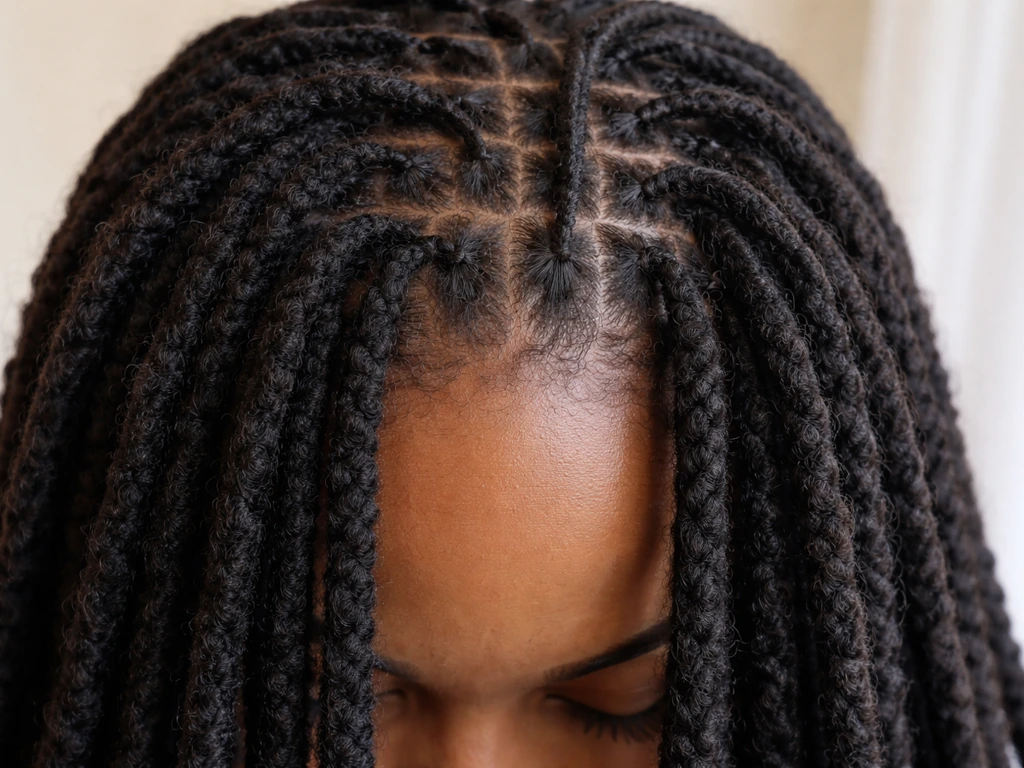
Hand-tied extensions do not increase actual hair growth. For related information on growth with other extension methods, see does your hair grow with loc extensions. Your hair grows from follicles embedded in your scalp, and attaching extensions to your strands does nothing to change how those follicles behave. What hand-tied extensions can do is help you retain the length your hair is already growing by reducing daily manipulation, shielding ends from friction, and keeping strands tucked away. For people with textured or Black hair who struggle with breakage eating up every centimeter of new growth, that retention benefit is very real. But there is a hard limit: if installation is too tight, too heavy, or left in too long, extensions stop being protective and start causing the exact damage that makes growth feel impossible.
Do Hand-Tied Extensions Help Hair Grow? Guide for Textured Hair

Growth vs. retention: the verdict
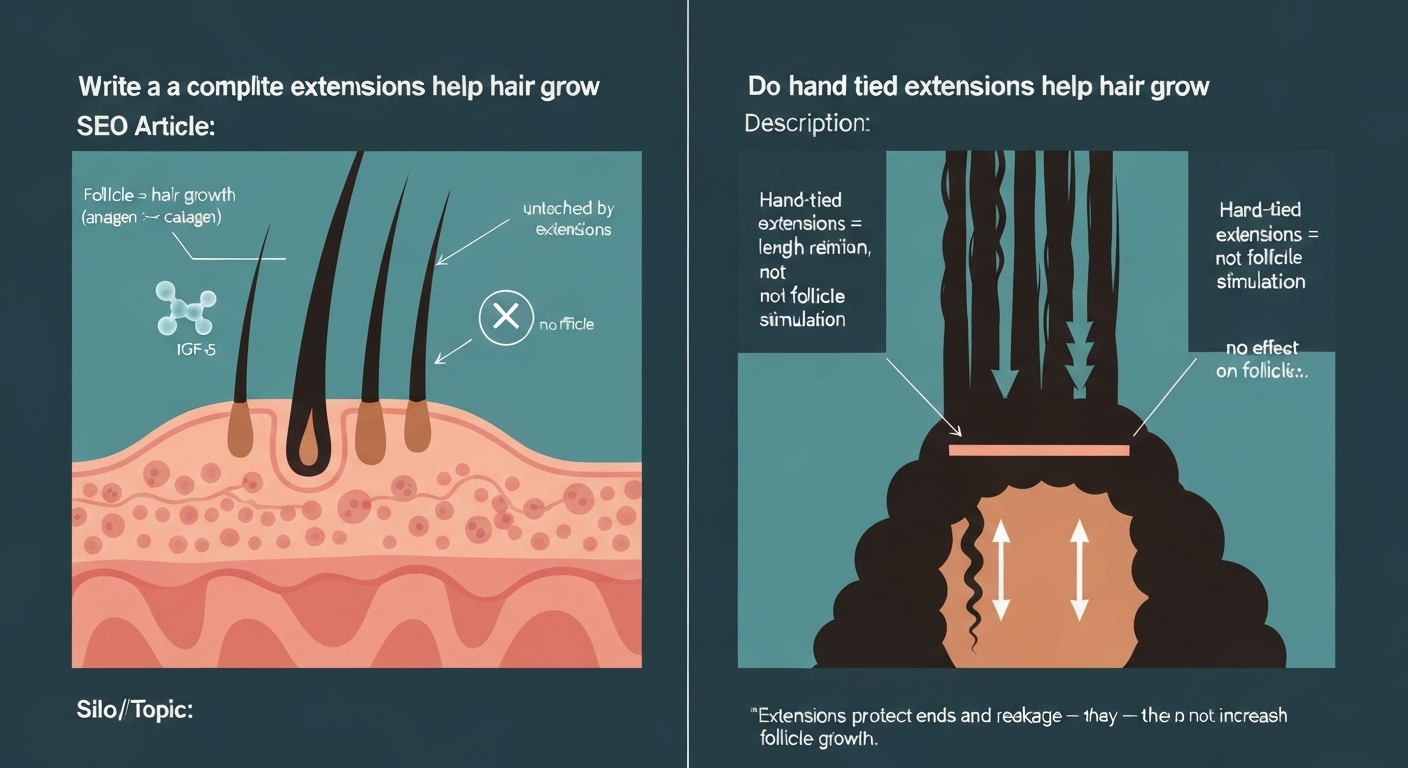
This distinction matters more than most people realize, and it is worth being blunt about it. Extensions do not stimulate follicles, speed up the anagen growth phase, or make your hair grow faster. If a stylist or a product page tells you otherwise, that is marketing, not biology. What protective styling with extensions can genuinely do is close the gap between how much hair your scalp produces and how much length you actually keep. For many people with coily and kinky textures, that gap is the real obstacle, not slow growth. Protecting length through low-manipulation styling is a legitimate strategy. Hand-tied extensions, done well, are one tool for that. Done poorly, they are a liability.
How hair actually grows (the biology your extensions cannot change)
Every strand on your head grows from a follicle that cycles through three phases: anagen (active growth), catagen (transition), and telogen (rest and shedding). During anagen, cells at the follicle base divide rapidly and push a new hair shaft up through the scalp. The length of your anagen phase is the single biggest biological factor controlling how long your hair can get. Genetics, hormones, nutrition, and health status all influence anagen duration. External attachments like extensions do not touch any of those factors.
Average scalp hair grows roughly 0.5 to 1.5 centimeters per month regardless of what you put on top of it. The molecular signals involved, including growth factors like IGF-1 and FGF-5, are regulated at the follicle level. No weft, however carefully hand-tied, reaches down to that cellular machinery. What you lose to breakage, tangling, and daily handling is the variable that lifestyle choices and protective styles can actually influence.
Shedding versus breakage is a distinction worth making here. Normal telogen shedding releases 50 to 100 hairs per day, complete with a white bulb at the root. Breakage snaps the shaft mid-length without a bulb, and it is usually the culprit when textured hair seems to stay the same length forever. Extensions can reduce breakage by limiting manipulation. They cannot reduce normal shedding, and under the wrong conditions they can dramatically increase breakage at the attachment points.
What hand-tied extensions actually are and how they sit on your scalp
Hand-tied wefts are strips of hair where individual strands are knotted by hand onto a very thin thread foundation rather than machine-sewn onto a thick fabric base. The result is a flat, narrow, and lightweight weft that sits close to the scalp with minimal bulk. Installation involves sectioning natural hair, creating a bead or foundation track, and sewing or beading the weft against the scalp row by row. Because the weft itself is thin, the profile is lower than a traditional sew-in, and the attachment points are more evenly distributed along each row.
From a scalp interaction standpoint, the key variables are tension at the attachment bead or thread, the weight load per row, how close the weft sits to follicles, and how the foundation method (beads, microlinks, sew) transmits mechanical force. A well-installed hand-tied weft distributes weight across multiple anchor points rather than concentrating it at a few tight knots. That is the theoretical advantage. In practice, how your particular stylist executes the installation matters far more than the weft type itself.
The science: why extensions cannot grow your hair but can help you keep it
The research on this is consistent and not especially complicated once you understand the biology. Follicle activity is governed by internal molecular signals, not by what is attached to the shaft. Studies on traction alopecia confirm this in a stark way: mechanical tension at the follicle does not stimulate growth, it suppresses it. Chronic tension produces perifollicular inflammation first, which is reversible if caught early. Left unaddressed, that inflammation progresses to scarring, which is permanent. A 2009 case series published in the British Journal of Dermatology documented that hair extensions, including wefted styles, caused acute hair loss, folliculitis, contact dermatitis, and traction-related alopecia, particularly when installations were tight or applied to chemically processed hair.
The retention argument is where extensions earn their place in a hair health strategy. Reviews of Afro-ethnic hairstyling practices note that protective styles, including weaves and extensions, reduce daily manipulation and therefore reduce the cumulative mechanical damage that leads to breakage. For coily textures with a naturally tighter curl pattern, high cuticle exposure, and more fragile moisture balance, keeping ends protected and minimizing detangling sessions has a measurable positive effect on length retention over time. The condition is that protective styling must actually be protective, meaning low tension, appropriate wear duration, and a maintained scalp underneath.
Real benefits of hand-tied extensions for textured and Black hair
When installed correctly, hand-tied wefts offer some genuine advantages over bulkier extension methods, particularly for textured hair types that are more vulnerable to tension and friction damage.
- Lower bulk at the scalp: the thin weft foundation creates a flatter profile, which reduces the localized pressure that machine wefts can create at each row.
- More distributed tension: because hand-tied wefts use multiple small anchor points rather than a few heavy load-bearing knots, tension is spread across a wider area of the scalp, lowering peak force per follicle.
- Reduced daily manipulation: once installed, hand-tied extensions eliminate the need for daily detangling of your natural hair, which is where a significant portion of breakage occurs for kinky and coily textures.
- End protection: natural hair ends, the oldest and most fragile part of each strand, are bundled into the weft and protected from environmental friction and moisture loss.
- Styling versatility: the low profile allows for higher ponytails, parting flexibility, and a more natural scalp appearance compared to traditional sew-ins, making it easier to switch styles without stressing attachment points.
- Compatibility with natural texture: because there is no glue or heat bonding, hand-tied wefts do not chemically alter or thermally damage the hair shaft at the point of attachment.
Risks you need to know: what can go wrong with textured and relaxed hair
I want to be direct here, because the risks are real and some of them are permanent. Traction alopecia is the primary concern with any extension method, and it is not rare. Hairstyles that pull can lead to hair loss - American Academy of Dermatology patient education notes that weaves, sew‑ins, braids, and extensions are recognized causes of traction alopecia and recommends avoiding persistent tight styles and modifying techniques to reduce tension. Studies in populations of African descent report prevalence rates as high as 31.7 percent in some cohorts of adult women, with risk increasing significantly when extensions are combined with chemical relaxers. Relaxed hair is structurally weakened at the cortex level, which means it transmits mechanical force to the follicle less efficiently and snaps under tension that healthy natural hair might absorb.
- Traction alopecia at the hairline and temples: the most common damage pattern from extensions, especially if beads or attachment points are placed close to the hairline with high tension. Early signs are reversible; chronic traction is not.
- Breakage at the weft attachment: where the natural hair is bent around a bead or tied into a knot, repeated flexion and stress concentration can cause shaft breakage at that precise point, creating short, frizzy regrowth that is often mistaken for new growth but is actually broken hairs.
- Matting and tangling: shed hairs that cannot escape the weft accumulate over time and form compacted mats at the root. These mats create uneven tension across the scalp and can cause tearing during removal if not properly addressed.
- Scalp inflammation and folliculitis: any bead or weft that sits flush against the scalp can trap sebum, product buildup, and moisture. Without adequate cleansing, this environment supports bacterial or fungal growth, leading to pustules and scalp soreness.
- Contact and irritant dermatitis: materials used in wefts (dyes, synthetic fibers in lower-quality products) or bonding adhesives for bead coatings can provoke allergic or irritant reactions, particularly on sensitive or already-inflamed scalp skin.
- Weight-related stress on relaxed hair: chemically relaxed strands have reduced tensile integrity, meaning added weft weight translates more directly into follicle tension than it would on unprocessed hair. This combination is explicitly flagged in clinical literature as a higher-risk scenario.
The clinical warning signs to watch for are perifollicular redness, tenderness or pain at attachment points, pustules or flaking, noticeably increased shedding at the rows, and the 'fringe sign', which is a band of short broken hairs along the hairline that looks like stubble. Any of these should prompt either a visit to a dermatologist or immediate removal of the style. Continuing to wear the style after these signs appear is how early, reversible damage becomes permanent scarring.
How different extension methods compare for growth and length retention
Not all extensions carry equal risk profiles. The method of attachment, the weight of the added hair, and the type of contact with the scalp all affect how much tension reaches your follicles. Here is how the most common methods stack up, keeping in mind there are no randomized controlled trials comparing them directly. These comparisons are based on clinical reports, biomechanical principles, and professional consensus.
| Method | Attachment Type | Scalp Contact | Tension Distribution | Key Risk for Textured Hair | Approximate Wear Duration |
|---|---|---|---|---|---|
| Hand-tied weft | Beads or sew on thin weft | Low profile, close but flat | Distributed across row | Traction at bead points, matting if worn too long | 6 to 8 weeks |
| Machine sew-in weft | Sewn onto braided cornrow | Moderate, thicker weft edge | Concentrated along cornrow track | Traction at cornrow edges, scalp dryness under weft | 6 to 8 weeks |
| Glued/bonded weave | Adhesive keratin bond | High, bond sits on scalp | Concentrated at each bond point | Heat damage during removal, shaft breakage, folliculitis | 4 to 6 weeks |
| Clip-in extensions | Pressure clips, temporary | Intermittent only | Point-loaded at clips, but temporary | Clip pressure with daily use, hairline thinning if used every day | Worn same day, removed nightly |
| Dread/loc extensions | Interlocked, crocheted, or looped onto existing locs | Variable, depends on method | Concentrated at loc base | Traction at loc root, added weight on young or thin locs | Permanent or semi-permanent |
Clip-ins carry the lowest sustained tension risk because they are removed daily, but daily clipping and unclipping near the same areas does accumulate stress over time if the wearer relies on them heavily. Glued bonds introduce heat and chemical exposure that machine wefts and hand-tied wefts avoid. Dread and loc extensions are a distinct category with their own growth and retention dynamics, and the question of whether loc extensions grow follows different logic than weft-based methods because the base hair is already structured differently.
If you are comparing hand-tied wefts to traditional sew-ins and asking which is safer for textured hair, the honest answer is: it depends almost entirely on installation quality. The potential advantage of hand-tied wefts (lower bulk, better tension distribution) disappears immediately if the stylist pulls the bead tight against an overstressed hairline. The method matters less than the skill and care of the person installing it.
What happens when hand-tied extensions grow out
As your natural hair grows, the attachment points (beads or sewn rows) migrate away from the scalp. This creates a visible gap between the scalp and where the weft begins, often called 'grow out.' At roughly the six-week mark, most people notice the rows sitting noticeably lower, the weft starting to feel looser or slightly shifted, and the potential for more movement and friction at the bead site. For more detail, see the section on what happens when hair extensions grow out. For specific guidance on whether loc extensions grow with your natural hair, see do loc extensions grow. By eight weeks, the gap is typically large enough that the weft hangs with more weight suspended on a longer section of hair rather than sitting supported close to the scalp, increasing the per-follicle load.
This is the window when matting becomes a serious issue. Shed hairs, which have been releasing at their normal rate during the entire wear period, are trapped in the weft structure instead of falling away naturally. By week six or seven, there can be six to eight weeks worth of shed hairs compressed at the root, creating dense tangles. At this stage, what looks like significant volume at the base is mostly matted shed hair, not new growth anchored to the weft.
How to tell if your natural hair has actually grown versus the weft just shifting: when you remove the extensions and detangle carefully, measure your natural hair from root to tip in its stretched state. Compare that to your pre-installation measurement. Growth of roughly half a centimeter to one centimeter per month is normal. If you see more than that, double-check your measurement method. If you see less, it usually points to breakage at or near the attachment points rather than slow growth from the follicle.
Reinstallation timing is not just a cosmetic preference, it is a scalp health decision. The professional guidance most commonly cited in salon settings recommends a move-up or reinstallation cycle of six to eight weeks, with a period of at least one to two weeks of no extensions between sets to allow scalp inspection, deep conditioning, and structural assessment of the hair. Johns Hopkins Medicine recommends removing weaves after approximately eight weeks and alternating styles to allow the scalp time to recover. Johns Hopkins clinicians advise removing weaves after approximately eight weeks and alternating styles to give follicles a recovery window.
Best practices: keeping your hair healthy while wearing hand-tied extensions
This is the part where the real difference gets made. Extensions are a neutral tool and what you do during the wear period determines whether they help or harm your natural hair.
- Get a professional consultation before installation, specifically about tension. Your stylist should not be able to see scalp tenting (skin lifting away from the scalp) at any attachment point.
- Cleanse the scalp every one to two weeks with a diluted sulfate-free shampoo applied in lines along the rows. Buildup under wefts is a direct path to folliculitis.
- Moisturize your natural hair through the weft using a lightweight water-based leave-in conditioner or diluted aloe vera gel applied with a bottle applicator. Your hair is still alive under the weft and needs hydration.
- Sleep with a satin or silk bonnet or pillowcase every night to reduce friction at the weft edge and prevent frizzing and matting at the roots.
- Avoid any additional tension over the weft: tight high ponytails, heavy headbands sitting directly on rows, or gym headbands that compress the same area repeatedly.
- Do not leave the style in beyond eight weeks. The risk of matting, traction, and scalp inflammation increases substantially after that point.
- Book removal with your stylist or follow a very careful self-removal protocol with a weft-safe solvent and plenty of detangling time. Forced removal is where the most dramatic breakage happens.
- Take a one to two week break between sets. Use this window to protein treat if your hair is feeling limp or stretchy, deep condition, and genuinely examine the scalp and hairline for any of the warning signs listed above.
- If you have chemically relaxed hair, build in extra scrutiny at the overlap zone where new growth meets relaxed hair. This zone is the structurally weakest point and where bead placement should be approached most conservatively.
When to remove extensions immediately
- Pain or scalp soreness that does not resolve within 24 to 48 hours of installation
- Visible redness, bumps, or pustules at or near any attachment point
- Noticeable increase in shed hairs at the rows compared to your normal rate
- The 'fringe sign': a band of short broken hairs appearing along the hairline
- Any itching or burning that does not respond to scalp cleansing within a week
- Visible skin lifting (tenting) at bead or sew points
Restoring hair health after removal
After removing hand-tied extensions, your natural hair is going to need some attention regardless of how well the wear period went. The first step is a thorough but gentle detangling session, ideally done on wet, well-conditioned hair with a wide-tooth comb starting from the ends. Do not rush this. Matted shed hair needs to be separated gradually or you will cause the breakage you were trying to avoid with the protective style in the first place.
Follow removal with a clarifying wash to remove any product buildup or sebum accumulation from the wear period, then a deep conditioning treatment to restore moisture and elasticity. If your hair feels unusually stretchy when wet and then snaps, that is a sign of protein-moisture imbalance: try a light protein treatment followed by a moisturizing deep conditioner. If your scalp shows any of the early traction or inflammation signs, see a dermatologist before reinstalling, and consider pairing any styling changes with a targeted scalp treatment. Early-stage traction alopecia is reversible when tension is removed promptly; waiting and hoping while continuing the same style is how it becomes permanent.
Dos and don'ts at a glance
| Do | Don't |
|---|---|
| Use a stylist experienced with textured and Black hair specifically | Let anyone install extensions who cannot explain their tension approach |
| Cleanse the scalp every one to two weeks during wear | Skip scalp care because the weft makes it inconvenient |
| Moisturize natural hair through the weft with a lightweight leave-in | Assume your natural hair is 'fine' and needs no care under the extensions |
| Remove and reinstall within the 6 to 8 week window | Push past 8 weeks to avoid reinstallation costs |
| Take a break between sets and inspect the scalp thoroughly | Install immediately back-to-back without a recovery period |
| Use a satin or silk sleep protection every night | Sleep on cotton surfaces that cause friction and matting |
| Address pain or scalp symptoms within 24 to 48 hours | Tolerate pain or bumps because you 'just got them done' |
| Measure your natural hair before and after each set to track real growth | Assume the added length from extensions equals your hair growing faster |
The bottom line
Hand-tied extensions do not make your hair grow. That is the honest, evidence-supported answer, and it is not a knock on the method. For a deeper explanation, see our article on whether can your hair grow with extensions which explores the biology, common misconceptions, and practical tests to measure true growth. What they can do, when installed with appropriate tension by a skilled stylist and maintained properly during wear, is help you hold onto the growth your follicles are already producing. For people with textured and Black hair where daily manipulation, dryness, and breakage are the main obstacles to length, that is genuinely useful. The risk side is equally real: traction alopecia, breakage at attachment points, matting, and scalp inflammation are documented and can become permanent if warning signs are ignored. Whether hand-tied extensions help or harm your hair comes down almost entirely to how they are installed, how they are maintained, and how honestly you respond to what your scalp is telling you during the wear period.
FAQ
Do hand‑tied extensions actually make textured/Black hair grow faster, or do they mainly help retain length?
Hand‑tied extensions do not change the hair follicle’s biology (anagen duration or intrinsic growth rate). They mainly help with length retention by reducing daily manipulation and breakage when installed and maintained with low tension. Any apparent ‘‘faster’’ length is usually less breakage and better preservation of existing growth, not an increased growth rate.
What’s the basic biology behind scalp hair growth that explains this?
Scalp hair grows in cycles (anagen = growth, catagen = transition, telogen = rest). Anagen length and follicle activity determine how fast and how long hair can grow; these are regulated by molecular signals inside the follicle. Mechanical attachments like extensions don’t lengthen anagen. Extensions can, however, change physical stresses on follicles and shafts, affecting breakage and retention.
When do extensions help hair health vs. when do they harm it?
Help: when used to reduce daily friction/manipulation, installed with minimal tension, light wefts, and regular maintenance; they protect ends and let hair rest. Harm: when too tight, too heavy, left on too long, or combined with chemically weakened hair—this raises risk of traction alopecia, folliculitis, breakage, and irreversible scarring if repeated over time.
Are hand‑tied extensions safer than other extension types for textured/Black hair?
Hand‑tied wefts are often thinner and lie flatter, so they can be lower‑profile and potentially less bulky than machine wefts or glued weaves. Compared with other methods: - Sew‑ins (weft sewn to cornrows): similar traction risk if sewn tightly or heavy. - Glued weaves: risk of adhesive damage, difficulty removing, scalp irritation. - Clip‑ins: lowest continuous traction risk because removable, but bulky/clips can stress localized spots. - Dread/loc extensions: different mechanics—can reduce manipulation but improper attachment causes tension. No high‑quality trials prove one method is universally safer; safety depends on installation technique, weight, tension, and client hair condition.
What specific risks do hand‑tied extensions pose for textured or chemically relaxed hair?
Risks include traction alopecia (especially along hairline and parts), increased breakage at attachment points, perifollicular inflammation/folliculitis, contact dermatitis from adhesives or weft materials, and exacerbation of damage when combined with relaxers/bleaching. Chemically weakened hair has lower shaft and follicle tolerance for additional mechanical stress, increasing damage risk.
How long can I safely keep hand‑tied extensions in? What are realistic timelines?
Common professional guidance is 6–8 weeks maximum per installation for most weft and sew‑in systems to prevent concentrated, chronic tension. Shorter intervals (4–6 weeks) are safer for chemically altered or fragile hair. Regular move‑ups/retightening every 4–8 weeks and alternating styles every few months reduces cumulative stress.
Do Loc Extensions Grow? What Really Increases Length
Do loc extensions grow real length? Learn what grows underneath, what adds bulk, plus care tips to retain length.