Soft locs do not grow your hair faster. No hairstyle can do that. What soft locs can do, when installed and maintained correctly, is protect your strands from the daily breakage and manipulation that stop length from accumulating in the first place. For most people with textured or Afro-type hair, that protection is the real prize, and it is genuinely valuable. But calling it 'growth' is a myth worth dismantling clearly, because chasing the wrong goal leads to the wrong habits and, sometimes, real damage.
Do Soft Locs Grow Your Hair? Growth vs Retention Guide

Simone Okonkwo
15 Jul 2026
Growth vs. length retention: why this difference matters
Hair growth is a biological process happening entirely inside the follicle, below the skin surface. A healthy follicle in the anagen (active growth) phase produces roughly 0.77 cm of new hair per month for people of African descent, based on clinical phototrichogram measurements. Asian hair cohorts average closer to 1.2 to 1.3 cm per month in the same studies. Those numbers are set largely by your genetics, hormones, and nutritional status. No topical product, style, or technique changes them meaningfully.
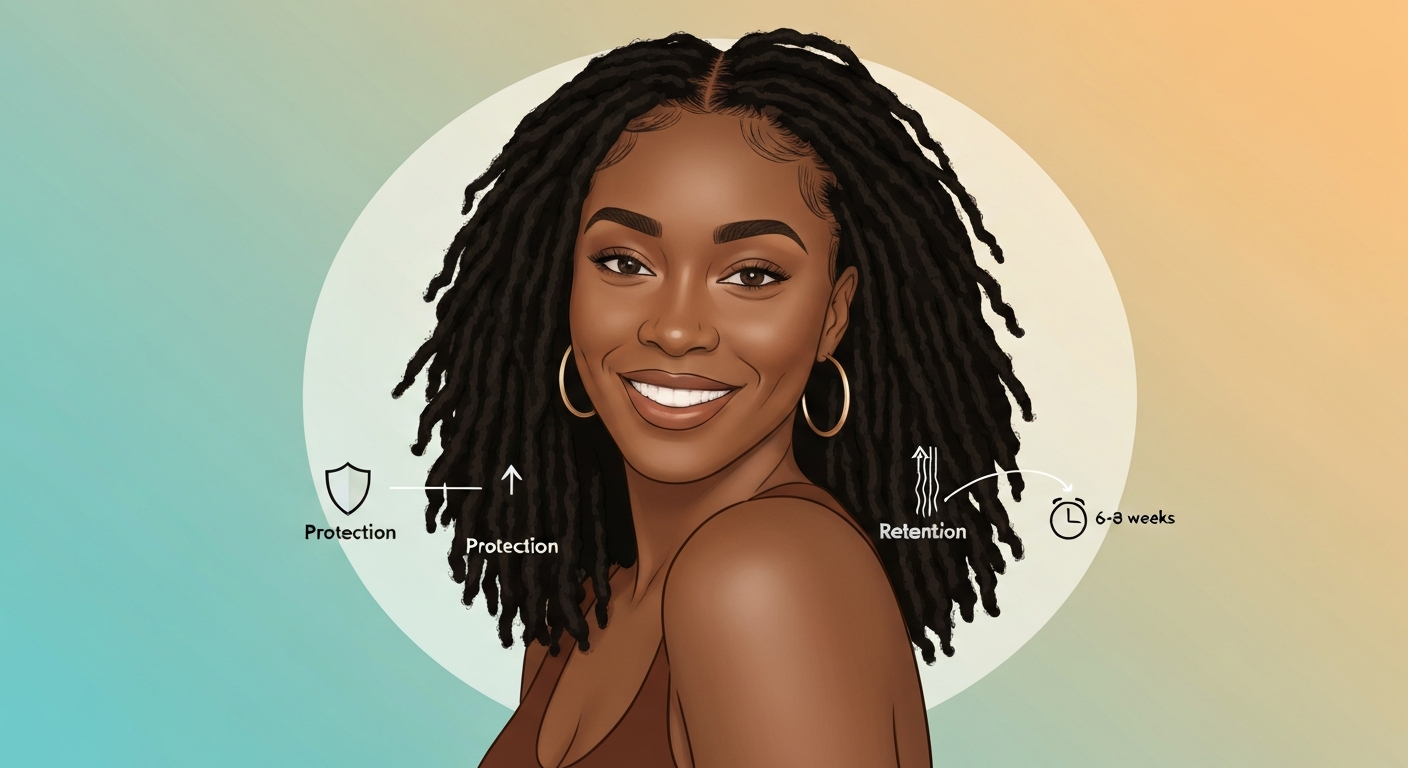
Length retention is something different. It is the proportion of that grown hair that survives long enough to be seen and measured. Textured hair, especially tightly coiled Afro-type strands, has a smaller mean fiber diameter and distinctive mechanical properties that make it more vulnerable to breakage under tensile stress. If your hair is breaking at the same rate it is growing, you stay at the same length permanently. That is the frustrating plateau many people hit, and it is where protective styles, including soft locs, can genuinely help.
How hair actually grows: the real drivers
The follicle cycles through three phases: anagen (growth, lasting two to seven years), catagen (brief transition), and telogen (rest and shedding, lasting roughly three months). The proportion of follicles in anagen at any time, your anagen-to-telogen ratio, determines how much active growth is happening on your scalp. Phototrichogram technology and tools like TrichoScan can measure this non-invasively, and they are considered precise enough to validate against scalp biopsies in research settings. Here is what actually moves those numbers.
- Genetics: your baseline growth rate, hair density, and follicle cycle length are largely inherited
- Hormones: androgens, thyroid hormones, and estrogen all regulate follicle cycling; imbalances (thyroid disease, postpartum hormonal shifts, PCOS) commonly cause shedding
- Nutrition: iron (tracked via serum ferritin) and vitamin D have the strongest links to non-scarring alopecia in meta-analyses, though causality is complex; correcting a documented deficiency can restore normal shedding patterns, but supplementing without deficiency shows mixed evidence at best
- Age: follicle density and anagen duration naturally decline with age; hair miniaturization accelerates for many people after their 40s
- Scalp health: chronic inflammation from seborrheic dermatitis, dandruff, or traction injury can disrupt the follicle environment and secondarily impair retention
Nothing on this list involves hairstyle choice. A style can reduce breakage. It cannot reprogram your follicles. Once that is clear, you can make much smarter decisions about protective styling.
How protective styles influence retention (and when they backfire)
Systematic reviews and clinical literature agree on what protective styles actually do: they reduce day-to-day shaft manipulation and environmental exposure, which limits mechanical breakage and weather-related damage. Less breakage means more of your grown hair sticks around. Over six to eight weeks in a style like soft locs, the cumulative difference in retained length can be significant, especially for someone whose hair previously broke constantly with daily manipulation.
The flip side is traction alopecia, and it is not rare. Dermatology research on cohorts of African descent reports prevalence estimates ranging from roughly 8% up to 20 to 30% in some clinic-based studies, depending on how traction alopecia is defined and which populations are studied. The established risk factors are tight installation close to the scalp, heavy or long extensions adding downward weight, prolonged continuous wear, and combining tight styles with chemical processing like relaxers. Dermatology societies uniformly recommend avoiding persistent tight styles, see Hair loss: Tips for managing - American Academy of Dermatology (patient guidance). Traction alopecia starts as reversible early-stage inflammation and hairline recession, but if the tension is sustained, follicle scarring can become permanent. At that point, no style, product, or supplement brings the hair back.
What are soft locs exactly?
Soft locs are a protective style that mimics the appearance of mature traditional locs but is installed using synthetic extension hair wrapped around your natural hair, which is usually braided or twisted into a base first. The 'soft' name refers to the texture: the wrapping technique creates a looser, more flexible loc than some other faux-loc methods, and the finished style tends to look more distressed or naturally bohemian than traditional locs.
Types of soft locs
- Butterfly locs: created by looping the extension hair over itself to create a wavy, undone texture; the loops give the loc a lighter, airy look
- Distressed soft locs: a similar looping technique with a more irregular, lived-in finish
- Water wave soft locs: use pre-crimped or water-wave extension hair for a different surface texture
- Goddess locs: usually include some loose, flowing extension ends for a mixed finish
Common installation methods
The most common base is a braid or a two-strand twist using your natural hair. Extension hair, typically a synthetic like Marley hair, water-wave hair, or pre-looped faux-loc hair, is then wrapped or looped around that base from root to tip. The ends are often sealed with hot water dipping, which causes the synthetic fibers to shrink and lock in place without glue or heat directly on your natural hair. Installation time typically runs four to eight hours depending on length, thickness, and the number of sections. Finished weight per loc varies significantly depending on how much synthetic hair is used, and that weight is relevant to traction risk.
Soft locs vs. faux locs, butterfly locs, and traditional locs: what actually differs
Understanding the distinctions between these styles matters because their risk profiles and maintenance demands are meaningfully different. Faux locs, butterfly locs, and soft locs are all temporary extensions installed over your natural hair. Traditional locs and reattached locs are a different category entirely, involving your own hair locking over months or years. Each style creates different tension dynamics, weight loads, and scalp-access conditions. For a focused answer about butterfly locs specifically, see does butterfly locs grow your hair.
| Style | Base material | Weight/tension | Wear duration | Traction risk | Scalp access |
|---|---|---|---|---|---|
| Soft locs | Synthetic wrapped over natural braid/twist | Moderate to high depending on thickness | 4 to 8 weeks typical | Moderate; depends heavily on installation tension | Limited |
| Butterfly locs | Synthetic looped over natural braid/twist | Lighter than traditional faux locs due to loops | 4 to 6 weeks typical | Moderate; lighter loops reduce weight but base tension still applies | Limited |
| Faux locs (crochet or wrapped) | Synthetic attached via crochet or wrapping | Moderate to high | 4 to 8 weeks | Moderate to high; crochet method can be gentler | Limited |
| Traditional locs | Natural hair only | Low early stage, increases as locs mature and lengthen | Long-term, months to years | Low to moderate if installed with loose tension | Good between maintenance |
| Reattached locs | Natural detached locs reattached to scalp hair | Can be heavy; depends on loc length and density | Long-term | Moderate to high at reattachment points | Good between maintenance |
If you are exploring how traditional locs compare to these temporary styles in terms of long-term outcomes, there is more detail on the mechanics of true locs and their effect on hair health in related coverage of whether locs grow your hair. Similarly, butterfly locs and faux locs each have specific nuances in how they load the scalp and how that translates to retention outcomes, which are covered in dedicated articles on those styles.
Do soft locs actually stimulate hair growth? The honest evidence
I want to be direct here: there is no clinical trial, controlled study, or validated mechanism showing that soft locs, butterfly locs, faux locs, or any comparable synthetic extension style accelerates follicular hair production. See the related discussion on do faux locs grow hair for specifics about faux locs and hair growth claims. Research specifically measuring hair growth outcomes for soft locs or butterfly locs does not exist in any meaningful volume. What exists is a broader body of traction alopecia literature, case reports, and observational data that tells us when these styles help and when they hurt.
The idea that soft locs grow hair typically comes from a real but misidentified experience: someone installs soft locs, keeps them in for six to eight weeks, removes them, and notices their hair is longer than before. What actually happened is that the style reduced the breakage that was previously erasing their growth. The follicles were growing hair the whole time at their genetically programmed rate. The style just let more of it survive. That is still a win, but it is a fundamentally different thing, and calling it growth creates unrealistic expectations.
There is also the scalp stimulation argument, the idea that the weight or movement of locs massages the scalp and increases blood flow to follicles. This is a popular claim in hair communities. There is some preliminary research suggesting scalp massage may modestly improve hair thickness over time, but the evidence base is thin and the effect sizes are small. There is no evidence that synthetic extension weight replicates therapeutic scalp massage in any meaningful way.
Where soft locs genuinely help: retention and breakage prevention
For the right candidate, soft locs can be an excellent retention tool. Afro-textured hair's structural properties, including its elliptical cross-section, tight curl pattern, and relatively smaller fiber diameter compared to straight hair types, make it physically more prone to breakage at points of mechanical stress. Combing, brushing, washing aggressively, sleeping on cotton, and daily environmental friction all create that stress. Soft locs eliminate most of it for the duration of the wear period. Less manipulation, less breakage, more retained length.
The scalp-access limitation under soft locs also cuts both ways. On the positive side, your ends and mid-lengths are bundled into the synthetic wrap and not being touched. On the negative side, your scalp is harder to cleanse properly, and research on scalp microbiome and seborrheic dermatitis shows that reduced wash frequency plus low airflow under occlusive styles can shift the scalp microbiome toward inflammation, dandruff, and itching. For Afro-textured hair specifically, sebum transport along the tightly coiled shaft is already reduced compared to straighter hair types, meaning the scalp already tends toward dryness and inflammation under some conditions. If you go six weeks without proper scalp cleansing, you can end up with the kind of inflammatory environment that impairs the very retention you were trying to support.
What the research says about traction and damage risk
Clinical reviews consistently identify the same culprits for traction-related damage in extension styles: high installation tension, especially at the hairline and temples; heavy extensions adding persistent downward pull; long continuous wear duration; and the combination of tight styles with chemically relaxed or heat-processed hair. Soft locs can tick multiple boxes if not installed carefully. The good news is that the key variables are controllable. You can ask for looser installation. You can choose thinner locs that carry less extension weight. You can commit to an eight-week maximum wear rather than stretching to fourteen weeks. Each of those choices meaningfully reduces risk.
Installing soft locs to maximize retention and minimize damage
Preparation matters as much as the installation itself. Your hair should be in its best possible condition before soft locs go in, because they will be under wraps for weeks with limited ability to treat issues that arise. That means a thorough protein-moisture balance treatment beforehand, trimming any split or severely damaged ends (breakage that is going to happen will happen regardless, and damaged ends invite more splitting), and going into the appointment with a clean, healthy scalp.
- Wash and deep condition your hair two to three days before installation, not the same day, so your strands are hydrated but your scalp is not oversaturated
- Ask your stylist to leave at least one to two finger-widths of slack at the root; if it hurts during installation, say something immediately
- Opt for medium-sized locs rather than very thin (which require more braiding points) or very thick (which become heavy)
- Keep loc length at or below shoulder length if you are new to the style; longer locs add significantly more weight at the root
- Avoid installing soft locs over recently relaxed or bleached hair; the chemical weakening plus traction is a well-documented high-risk combination
- Have the stylist start sections away from the hairline with the least tension, then work toward the perimeter with the loosest possible installation at the edges
Caring for your hair while in soft locs
Maintenance during wear is where most retention gains are either locked in or lost. The scalp still produces sebum, collects product buildup, and can develop inflammation. You cannot just install soft locs and ignore your hair for eight weeks.
Weekly and daily care checklist
| Frequency | Task | Why it matters |
|---|---|---|
| Daily | Lightly spray roots and scalp with a diluted water and leave-in conditioner mix | Prevents scalp dryness and itching that can trigger scratching-related breakage |
| Daily | Sleep with a satin or silk bonnet or pillowcase | Reduces friction on the locs and the hairline while you sleep |
| Every 1 to 2 weeks | Diluted shampoo scalp wash (focus on scalp, not locs) | Removes sebum and product buildup that can inflame the scalp microbiome |
| Every 1 to 2 weeks | Light oil or serum applied to the scalp and hairline | Maintains scalp barrier; use lightweight, non-comedogenic oils like jojoba or squalane |
| Every 2 to 4 weeks | Edge care: gently clean hairline and apply a non-tensioning edge control if desired | The hairline is most vulnerable to traction; keeping it clean and lightly moisturized supports it |
| At 4 to 6 weeks | Honest assessment: check for tension headaches, persistent itching, or hairline thinning | Early signs of traction or inflammation are reversible; ignored, they can become permanent |
Ingredients worth having in your routine
Not every product marketed for protective styles is worth buying, but some ingredient categories have genuine utility during an extended protective style wear.
- Zinc pyrithione or selenium disulfide: proven antifungal and antimicrobial agents in scalp shampoos; peer-reviewed research supports their role in managing dandruff and rebalancing scalp microbiome under conditions of reduced wash frequency
- Jojoba oil and squalane: lightweight, non-comedogenic scalp oils that mimic sebum without occlusion; good choices for daily or every-other-day scalp moisture without buildup
- Glycerin and aloe vera: humectants that support moisture retention in the hair shaft; useful in diluted spray-bottle applications between washes
- Panthenol (pro-vitamin B5): supports hair fiber integrity and reduces breakage in cosmetic studies; a good ingredient to look for in leave-in conditioners used before installation
- Biotin and collagen topicals: popular but the evidence for topical delivery affecting follicle output is weak; internal biotin supplementation is only relevant if you have a documented deficiency
How to measure whether soft locs are actually working for you
If you want to know whether your protective styling routine is genuinely improving your length retention, you need a consistent measurement method. Clinical researchers use phototrichogram technology and tools like TrichoScan to measure hair density and growth rates non-invasively, but you do not need lab equipment to track retention meaningfully at home.
- Before installation, take a photo of your stretched hair length against a fixed reference point, like a ruler taped to a wall or a marked measuring tape; note the date
- After removal, stretch the same section of hair to the same reference point and photograph again
- Calculate the difference; if your average growth rate is roughly 0.77 cm per month and you wore the style for eight weeks, you should expect around 1.5 cm of new growth; if you retained most of that, the style worked
- Track hairline density separately: photograph your temples and edges before and after every install; early traction alopecia shows as thinning or recession at these points before you notice shedding elsewhere
- Note shed hair count at removal: some shedding is normal (roughly 50 to 100 hairs per day that accumulated during wear); excessive clumps or obvious thinning at the root signals a problem
Warning signs that soft locs are hurting rather than helping
Protective styles can and do cause damage when applied or worn incorrectly. Knowing what to look for is not optional. Early-stage traction alopecia is reversible. Late-stage scarring is not.
- Pain or a tight sensation at the scalp during or immediately after installation: this is not normal and is not something you 'get used to'; request looser installation or remove the style
- Pimples, bumps, or persistent itching along the hairline: early signs of follicular stress or scalp inflammation
- Visible scalp pulling or skin tenting at the roots: indicates the installation tension is high enough to physically distort the skin
- Broken hairs shorter than 1 to 2 cm at the hairline when you remove the style: evidence of traction breakage
- Hairline recession or temple thinning visible in photos compared to pre-installation: this warrants removing the style and consulting a dermatologist before reinstalling
- Persistent tenderness at specific loc attachment points weeks after installation: the tension has not released and the follicles are under chronic stress
When to remove soft locs and when to see a professional
The standard guidance from dermatology is to treat extended protective styles as a rotation tool, not a permanent state. For soft locs, eight weeks is a reasonable maximum for most people; some stylists recommend six weeks for first-time wearers or those with fine or fragile hair at the edges. After removal, take a minimum of one to two weeks in a low-manipulation style before reinstalling. This lets you assess the condition of your edges and scalp honestly.
See a board-certified dermatologist, particularly one who specializes in hair loss or has experience with textured hair, if you notice persistent hairline thinning after more than one protective style cycle, if you have unexplained diffuse shedding unrelated to style choice, or if you have patches of hair loss anywhere on the scalp. A clinician can distinguish between traction alopecia, telogen effluvium (diffuse stress-related shedding), seborrheic dermatitis, or other conditions that require different treatment. Guessing and trying more styles without diagnosis often delays intervention until permanent follicle damage has occurred.
Realistic expectations: what soft locs can and cannot do
Used thoughtfully, soft locs are a legitimate retention tool for textured hair. Installed with reasonable tension, maintained with regular scalp cleansing, worn for a sensible duration, and removed before damage accumulates, they allow weeks of minimal manipulation that can meaningfully add up in retained length over multiple styling cycles across a year. For someone whose hair previously broke at the same rate it grew, that is a real and measurable improvement.
What they cannot do is override genetics, fix a nutritional deficiency, rescue damaged follicles, or produce hair faster than your body is programmed to produce it. Vitamin D deficiency has been found at higher rates in some non-scarring alopecia cohorts (alopecia areata, female pattern hair loss) in meta-analyses, though causality and benefits of supplementation remain uncertain; screening and correcting deficiency is commonly advised in practice Vitamin D deficiency has been found at higher rates in some non-scarring alopecia cohorts (alopecia areata, female pattern hair loss) in meta-analyses, though causality and benefits of supplementation remain uncertain; screening and correcting deficiency is commonly advised in practice.. The 'soft locs made my hair grow' story is almost always a length retention story told without the right vocabulary. Rename it accurately and you will approach protective styling with the right goals, the right measurements, and a much lower risk of the tension and neglect damage that undoes all the retention you were trying to build.
FAQ
Short answer: do soft locs (and similar protective loc styles) make your hair grow faster or just help it retain length?
Evidence-based short answer: soft locs, faux locs, butterfly locs and similar protective loc styles do not biologically accelerate follicular hair production. They primarily help with length retention by reducing daily manipulation and mechanical breakage of the shaft. High-quality clinical tools (phototrichogram/TrichoScan) show that intrinsic hair growth rate is driven by biology (genetics, hormones, nutrition) rather than styling. However, when installed and managed correctly, these styles can produce better apparent length over time by preventing breakage and improving retention.
What biological factors actually determine true hair growth rate?
Hair growth rate is controlled by intrinsic biology: genetics, age, sex/hormones (thyroid, androgens), and systemic nutrition/status (iron/ferritin, vitamin D in some cases, protein intake). Medical conditions and medications can alter anagen/telogen dynamics. Protective styling cannot change these follicular drivers — it only changes how much of the produced hair survives and is measured as length.
How do installation method and tension affect outcomes with soft/faux/butterfly/reattached locs?
Installation matters a great deal. Low-tension, lightweight installs that avoid tight edges and excess weight reduce risk of traction alopecia and breakage and maximize retention. Tight braiding, close-to-scalp knots, heavy added hair, and long-duration high tension increase risk of follicular injury, especially at the hairline and temporal areas. Always ask your stylist for a loose/comfort-fit installation and avoid prolonged high-tension styles.
What scalp and hygiene issues should I watch for when wearing loc styles?
Common scalp concerns: sebum accumulation, itching, scaling/dandruff, product buildup and occlusion under attached hair. Reduced wash frequency and low airflow can promote microbiome shifts and inflammation that may cause shedding or worsen retention. Maintain a cleansing routine adapted to your hair texture and the style (see care checklist); treat persistent itching, pain, purulent drainage, or inflamed patches as warning signs and consult a clinician.
Are people with textured/Afro‑textured hair at greater risk of damage from these styles?
Afro-textured hair has structural features (tighter curls, reduced sebum transport, smaller mean fibre diameter) that make shaft breakage under tensile stress more likely. That means limiting manipulation, avoiding high tension, and managing scalp health are particularly important for retention and for avoiding traction alopecia in this group.
Can soft locs cause traction alopecia? What are the risk signs?
Yes—if installed or worn with excessive tension, weight, or for very long durations, soft locs can contribute to traction alopecia. Risk signs: receding edges, widened part lines, thinning at the temples/forehead, persistent scalp soreness/tenderness, 'pencil-eraser' sized scarred patches, and prolonged focal shedding. If you notice these, loosen styles immediately and consult a clinician/stylist.
Next Article
Do Faux Locs Grow Hair? What to Expect and How to Maximize Growth
Do faux locs make hair grow? Learn how they boost retention, plus care tips to prevent traction and maximize growth.