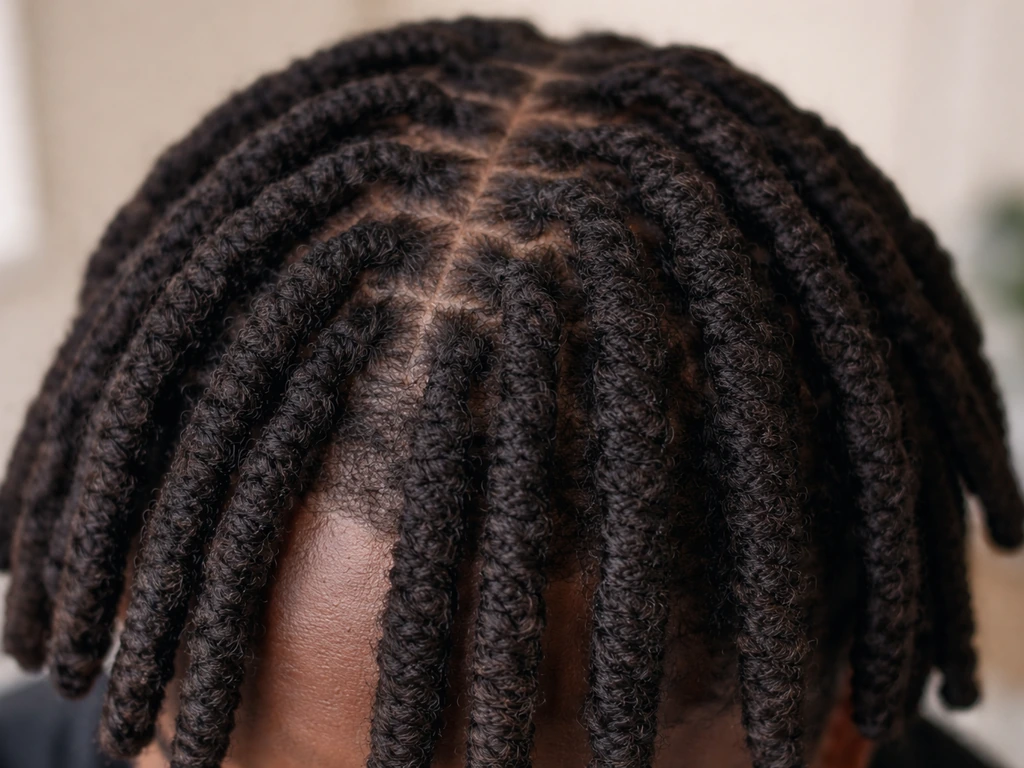
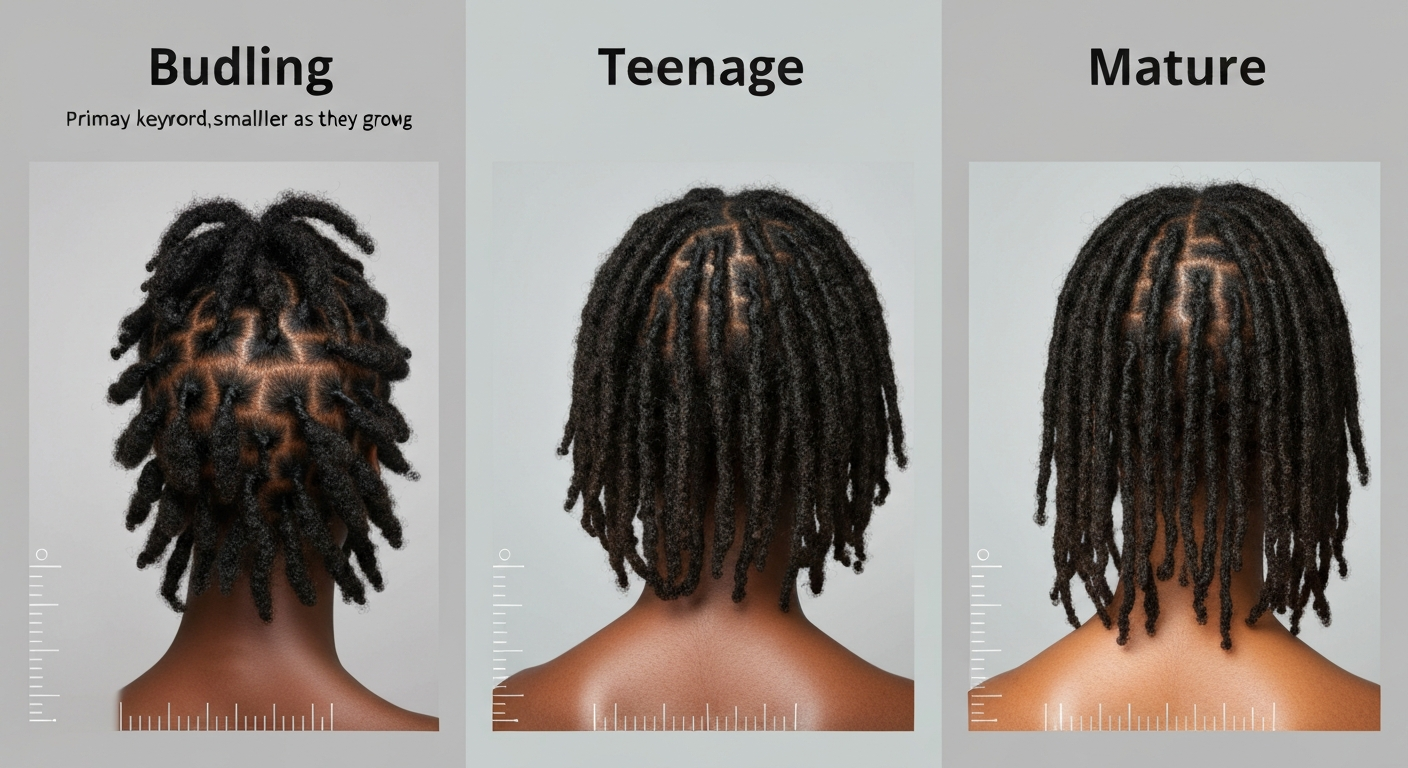
Yes, locs do change in diameter as they grow and mature, but the direction of that change depends on the stage your locs are in, your hair's texture and density, and how you maintain them. In the early months most locs puff up and feel thicker as the hair bundles and begins to mat together. Then, as full consolidation happens, many locs compact inward and can appear noticeably thinner than they did at the budding stage. This is normal. What people often panic about is not actual hair loss but natural structural change, though real thinning from tension and breakage is also possible, and those two things are worth learning to tell apart.
Do Locs Get Smaller as They Grow? Causes and Care Tips

Simone Okonkwo
29 Jul 2026
Key terms used in this article
Before diving in, here are five terms that will show up throughout this article. Getting familiar with them makes the mechanics much easier to follow.
- Shrinkage: the temporary or semi-permanent reduction in visible length (and sometimes apparent diameter) caused by the natural curl or coil pattern of textured hair contracting, especially when wet or during early loc formation.
- Consolidation: the process by which loose hairs within a loc interlock, felt, and compact into a tighter, denser cylindrical structure over months and years — this is the core biological mechanism behind mature locs.
- Maturation: the full lifecycle stages of a loc from starter through budding, teenage, and mature phases, during which both internal structure and visible diameter continue to change.
- Retained length: the actual length of hair you can see and measure in a loc, which is different from raw hair growth rate — protective styling helps retain length by reducing breakage, but locs still need healthy conditions to retain what grows.
- Spindling: thinning at specific points along a loc shaft or at the root, most often caused by chronic tension from tight retwisting, heavy loc weight, or repeated mechanical stress — it is a warning sign, not a normal stage.
Hair growth rate is not the same as retained length
Your scalp grows hair at blank" rel="noopener noreferrer">roughly 1 cm per month regardless of whether your hair is loose or locked. Some trichology research suggests the average can be slightly lower in tightly coiled hair types, but the fundamental biological machinery, the hair follicle cycling through anagen (active growth), catagen (transition), and telogen (rest) phases, does not care whether you have locs or a TWA. Locs do not make hair grow faster. If you're wondering whether do freeform locs grow faster, see the section comparing freeform and maintained methods for how retention and manipulation affect visible length. For a practical discussion specific to instantly formed starter styles, see Do instant locs grow which explains how instant locs change as they mature. For more on growth mechanics, see how do locs grow.
What locs genuinely help with is retention. Because the hair is bundled and not being manipulated daily with combs, brushes, or heat, breakage along the shaft is reduced. You lose less of what you grow. Over time this can result in noticeably longer locs than the same person might achieve with a high-manipulation style, but that is a retention story, not a growth story. Understanding this distinction matters because people often judge the health of their locs by visible length, when the real questions are: how much is actually growing, and how much of that growth is being preserved? For practical tips on how to make starter locs grow faster, see our guide on boosting early-stage loc growth.
The biology behind why loc diameter changes
Every individual hair fiber has a cross-section that is roughly elliptical rather than perfectly round, and that cross-section varies in size from person to person and even from strand to strand on the same head. The cortex, the thick keratin-filled core, is the dominant structure and largely determines a fiber's diameter. Clinical reference Anatomy, Hair Follicle - StatPearls (NCBI Bookshelf) notes the cortex is the keratin-rich core that largely determines fiber diameter and that thicker hairs commonly contain a medulla. In thicker individual strands you also often find a medulla (a porous central channel), which increases surface area and affects how readily fibers interlock with their neighbors.
When those fibers are grouped together in a loc, the diameter of that loc is primarily determined by two things: how many individual hairs are in the section, and how densely they are packed. During the maturation process, the fibers undergo a felting-like compaction. Dermatology research on hair matting describes exactly this mechanism: warm moisture, mechanical action, and repeated wet-dry cycling cause the cuticle scales of adjacent hairs to interlock and the bundle to compress. The result is a denser, smaller-diameter column than the loose bundle that existed at the start. This is not damage, it is literally how a loc becomes a loc. But it does mean your locs will almost always feel and look thinner at maturity than they did at the budding stage.
Hair also swells measurably when wet. Atomic force microscopy studies on hair fiber swelling show that the cuticle and cortex respond non-uniformly to moisture, causing transient changes in fiber diameter. In a loc, repeated swelling and drying across hundreds of fibers cycles the bundle through micro-expansions and contractions that, over time, drive further compaction. This is the same mechanical principle used in wool felting, a process documented in textile science that dermatologists have borrowed as an analogy to explain loc consolidation and sudden hair matting.
Porosity adds another layer. High-porosity hair (whether from genetics or chemical damage) absorbs and releases moisture faster, which means more frequent swelling cycles and, often, faster matting. This can speed up consolidation, but high-porosity hair also tends to be more structurally fragile, so the faster the loc forms, the more important it is to keep the hair moisturized and minimize excessive manipulation.
The mechanical reasons locs get thinner or thicker
Shrinkage
During the first several months, especially in tightly coiled (4B/4C) hair, the natural curl pattern causes dramatic shrinkage that makes locs look shorter and, in some orientations, denser or puffier. This phase is temporary in the length dimension but contributes to the internal reorganization that leads to compaction. Many people misread the puffiness of the budding phase as permanent thickness, then are surprised when mature locs look thinner. The hair hasn't thinned, it has just finished consolidating.
Matting and consolidation
As described above, this is the expected biological mechanism. The loc gets denser internally and therefore narrower externally. There is no way to have fully mature locs without some degree of compaction, it is the definition of a mature loc. The extent of compaction depends on hair texture (tighter coils consolidate more aggressively), product use (heavy butters and waxes can slow or disrupt clean felting), and washing frequency (too infrequent washing can build up product and lint that interferes with even consolidation).
Twisting and palm-rolling
Frequent, tight palm-rolling compacts the fibers inward mechanically. Done occasionally and gently, it helps shape the loc during the early stages. Done too aggressively or too often, it can over-compact the middle of a loc, leave weak points, or create the baseline for spindling. Loctician guidance consistently notes that many people over-manipulate during the starter phase out of anxiety about the locs looking neat, when a light touch actually produces healthier, more consistently sized mature locs.
Tension and traction
This is where diameter change stops being a normal developmental story and starts being a health concern. The American Academy of Dermatology and supporting dermatology literature are clear: chronic tension from tight styling, heavy loc weight, or repeated aggressive retwisting causes localized thinning and, if sustained, follicular damage that can become permanent. In locs, you typically see this at the root, a thin, wire-like base connecting the scalp to the bulk of the loc. This is spindling, and it signals that something mechanical is stressing the follicle. Heavy, mature locs on a fine or low-density hairline are particularly vulnerable. The weight of the loc itself is pulling on the root continuously.
Breakage
Breakage can reduce overall loc length and, if happening at the tip, can make locs look thinner at the ends. It is usually caused by dryness (especially in high-porosity hair that loses moisture quickly), chemical damage from dyes or relaxers applied to locs, or physical stress from tight accessories and rough handling. Keeping locs moisturized, with water as the primary vehicle and a light sealant like aloe vera gel or a diluted oil, is the single most effective maintenance step for reducing breakage.
Why locs can look thinner or thicker without actually changing
Perception plays a bigger role than most people realize. A freshly retwisted loc looks thicker because the new growth at the root is gathered neatly into the column, making the base appear fuller. Several weeks later, before the next retwist, that new growth has spread out and the root can look thin by comparison. This is not spindling, it is just unretightened new growth. Similarly, a loc that is very long will appear thinner than a short loc of identical diameter simply because of the aspect ratio. As weight increases with length, locs also hang differently and can look like they have narrowed.
Wet locs genuinely do change diameter temporarily. Because individual hair fibers swell with moisture, a loc right out of the shower has measurably different dimensions than the same loc fully dried. People who measure or compare their locs across wet and dry states are often comparing two different physical states, not a real change over time.
How your starter method shapes loc size and maturation
The single biggest determinant of final loc diameter is the size of your starting section. Larger sections produce thicker locs; smaller sections produce thinner ones. That relationship is fairly stable across methods. But the method does influence how quickly the loc consolidates, how it feels during the early phases, and how prone it is to certain problems.
| Starter Method | Early Appearance | Consolidation Speed | Diameter Outcome | Main Risk |
|---|---|---|---|---|
| Two-strand twists | Rope-like, visually fuller | Moderate — unravels before locking unless hair is coily | Can appear to thin significantly once the twist structure unravels and true felting begins | Premature unraveling in looser curl patterns |
| Comb coils | Tight, cylindrical, tidy | Moderate to fast in coily hair | Often compacts to a neat, consistent diameter | Can bud unevenly if not kept moisturized |
| Palm-rolling | Smooth, rounded column | Depends on frequency and texture | Can over-compact if done too aggressively, creating thinner mid-sections | Spindling from over-manipulation |
| Interlocking / crochet ('instant locs') | Compact, structured from day one | Fast — structure is immediate | Smaller diameter relative to section size because fibers are mechanically interlocked tightly | Thinning at interlock points if tool tension is too high |
| Freeform (no manipulation) | Organic, irregular, often merging | Varies widely | Can become thicker as adjacent hairs combine; final diameter is unpredictable | Uneven loc size, merging locs |
Two-strand twist starters often confuse people because the loc looks impressively full early on, that fullness is partly the twist architecture, not the true loc body. Once the twist structure releases and the actual felting begins, the loc can appear to shrink noticeably. This is not a problem; it is just the method working as expected. If you are using two-strand twists as your starter method and expecting that initial volume to be permanent, you are likely to be disappointed. For people wanting a realistic preview of mature thickness, comb coils tend to give a more accurate early indication.
Sisterlocks, micro-locs, and how small-scale locs behave differently
Sisterlocks use very small, precisely sized sections and a patented interlocking tool and retightening protocol. Because each loc starts with so few individual hairs per section, the baseline diameter is intentionally micro, much smaller than a traditional loc started on a comparable section. The interlocking method produces a compact, structured column immediately rather than going through the loose, fuzzy budding phase that twist or comb-coil starters experience.
This has a real implication for diameter change over time. Because the section is so small, there is less fiber mass to consolidate, and the locs stay narrow at maturity. Traditional locs started with a two-strand twist on a pencil-sized section will mature into something much thicker than a Sisterlocks installation on an equivalent area of scalp. Neither is superior, they are different outcomes by design.
The Medical News Today summary of Sisterlocks care notes that early, regular retightening is essential because with micro sections, the new growth at the root is proportionally more significant than in a thicker loc. Missing retightening appointments during the first year can cause the lock structure to weaken or the locs to thin and unravel at the roots rather than consolidating cleanly. For tips on how to grow Sisterlocks faster, including optimizing retightening schedules and moisture routines, see our guide on how to grow Sisterlocks faster. Overly aggressive retightening has the opposite problem: the small diameter means traction risk at the root is higher, and spindling can develop faster than it would in a heavier traditional loc.
If you are comparing Sisterlocks to traditional locs and wondering why your Sisterlocks look thinner as they grow, the answer is usually that they were always going to be thin, that is the design. The more important question is whether they look evenly thin along the entire shaft (healthy consolidation) or have visible weak points and narrowing at specific locations (spindling or tension damage). Micro-locs installed outside the trademarked Sisterlocks system follow similar principles but without the standardized maintenance protocol, which means results depend heavily on the skill and consistency of whoever is maintaining them.
What actually makes locs thicker or thinner over the long term
If you want thicker locs, the most impactful lever is section size, you cannot make a small section into a thick loc, no matter what you do to it later. For step-by-step guidance and proven habits on how to grow thick locs, see our detailed guide. After that, hair density (the number of follicles per square centimeter of scalp) determines how many individual fibers are contributing to each loc. Neither of these is something you can change through products or technique.
What you can influence is whether your locs retain the thickness they are biologically capable of. Here is what the evidence and practitioner guidance support:
- Keep locs moisturized. Dryness is the primary driver of breakage in textured hair, and breakage reduces both length and the fiber mass within a loc. Water is the first moisturizer; use it before any product.
- Use light, residue-free products. Heavy butters, waxes, and petroleum-based products trap lint, interfere with clean felting, and can cause buildup that weakens the loc's internal structure. Light oils (jojoba, argan) or diluted aloe vera gel are widely recommended by locticians for a reason.
- Wash regularly and thoroughly. Monthly at minimum for most people, more frequently in high-sweat or high-product-use situations. Residue buildup disrupts the natural felting process and can cause locs to feel spongy or develop odor and mold in the core.
- Retwist at intervals appropriate to your hair — not on a rigid calendar. Over-manipulation is one of the leading causes of root thinning and spindling. Many locticians recommend waiting until there is a visible inch or more of new growth before retwisting.
- Protect the edges and hairline. These are the most tension-vulnerable follicles. Avoid sleeping without a satin or silk cap or pillowcase, and be cautious with updos that pull the hairline consistently.
- Monitor for spindling actively. Run your fingers along each loc every few weeks and feel for narrowing. Catching it early means you can reduce tension before any follicular damage becomes permanent.
- Consult a loctician if you notice rapid or asymmetric thinning. Some thinning that looks like spindling is actually early-stage traction alopecia, which is reversible if caught early but not if ignored.
Troubleshooting: when thinning is something to worry about
Normal consolidation-related diameter reduction happens gradually, affects the whole loc fairly evenly, and leaves the root healthy and attached. The loc feels solid, not fragile, and the scalp shows no irritation. This kind of thinning is expected and nothing to treat.
Problematic thinning looks different. Watch for a loc that is noticeably narrower right at the scalp than it is further down the shaft, that is the tension signature. Watch for a loc that feels fragile at a specific point mid-shaft, bends sharply at that spot, or has already snapped at a weak point. Watch for scalp tenderness, itching, or redness at the base of particular locs. Watch for a receding hairline at the temples or nape, which are the zones most vulnerable to traction alopecia.
If you are seeing any of these signs, reducing tension is the immediate intervention: looser retwists, avoiding heavy updos, and giving the hairline rest. If the scalp symptoms persist or hair does not fill back in within a couple of months of reducing tension, see a dermatologist or trichologist rather than waiting. Traction alopecia that goes unaddressed long enough causes follicular scarring that no product or technique can reverse.
The honest state of the research
It is worth being transparent here: there are no published, peer-reviewed longitudinal studies that measured individual loc diameters at standardized intervals (starter, budding, mature) using calibrated instruments like scanning electron microscopy or optical micrometers. The science we have on hair matting and felting mechanics is solid and clearly applicable to how locs form. The individual hair fiber biology is well established. But specific, quantitative data on how much a loc compacts and at what rate, across different hair types and starter methods, does not exist in the controlled research literature yet. What we are working with is sound mechanistic reasoning from adjacent science plus consistent practitioner and wearer experience, which is meaningful, but honest about its limits.
FAQ
Short answer: Do locs get smaller (thinner) as they mature?
Short answer: Yes — locs commonly change diameter while they mature, but they don't follow one fixed pattern. Early stages often look bulkier (buds, swelling) then compact as fibers felt and consolidate; some locs end up slightly thinner in external diameter, others stay similar or appear thicker depending on hair density, starter method, and breakage or tension-related thinning.
What biological and mechanical processes make loc diameter change?
Loc diameter changes are driven by two main mechanics: 1) Felting/compaction: adjacent hairs interlock under moisture + agitation and progressively consolidate into a denser cylinder (documented in trichology as a matting/felting process). 2) Fiber-level behavior: individual hairs swell and shrink with moisture and have different diameters/cross-sections; packing changes (and loss of loose hair) change the loc's external size. Additionally, breakage or traction can remove fibers and reduce diameter locally.
How much change in diameter should someone expect?
There is no single numeric rule because final diameter depends on initial part size, hair count per section, fiber thickness, and maintenance. Clinically and in community reports, visual changes are common during the first months–years (noticeable budding → compaction). Quantitative longitudinal studies per loc are limited, so estimate changes qualitatively: modest reductions in apparent diameter from compaction are normal; large thinning usually signals breakage or traction.
How do starter methods (twists, comb coils, two-strand, interlock, instant locs, freeform, Sisterlocks) influence loc size and perception?
Starter method sets initial section size and early packing: - Two-strand twists/comb coils often begin with a fuller/ropey look that may compact moderately. - Crochet/instant locs create tight, compact columns immediately (smaller apparent diameter early). - Freeform begins with loose matting; locs may form uneven, sometimes thicker-looking sections. - Sisterlocks use very small partings, producing micro-diameter locs long-term. Maintenance frequency and technique after starting (palm-rolling, retwisting, interlocking, crocheting) further influence compaction and tension effects.
What's the difference between hair growth rate and retained loc length?
Hair growth rate (roughly ~1 cm/month on average, with texture and individual variance) is separate from retained length. Retained length equals growth minus loss from breakage, shedding, or shrinkage from curling and compaction. Locs often show less visible length early because of shrinkage and budded structure even though hair is still growing at the follicles.
Which factors make locs thicker or thinner over time?
Factors that influence diameter: - Hair density (more hairs per section → thicker loc). - Individual fiber diameter and curl pattern. - Porosity and moisture behavior (swelling/shrinkage affects packing). - Starter section size and method. - Mechanical manipulation: frequent tight retwisting/palm-rolling can compact or cause traction thinning. - Chemical or heat damage increases breakage → thinner locs. - Product build-up can stiffen or add bulk (apparent thicker), while clarifying reduces residue and may make locs look slimmer.
Next Article
Do Instant Locs Grow? What to Expect and How to Maximize Retention
Do instant locs grow? Learn real expectations, what thickens vs what grows, and how to maximize retention safely.